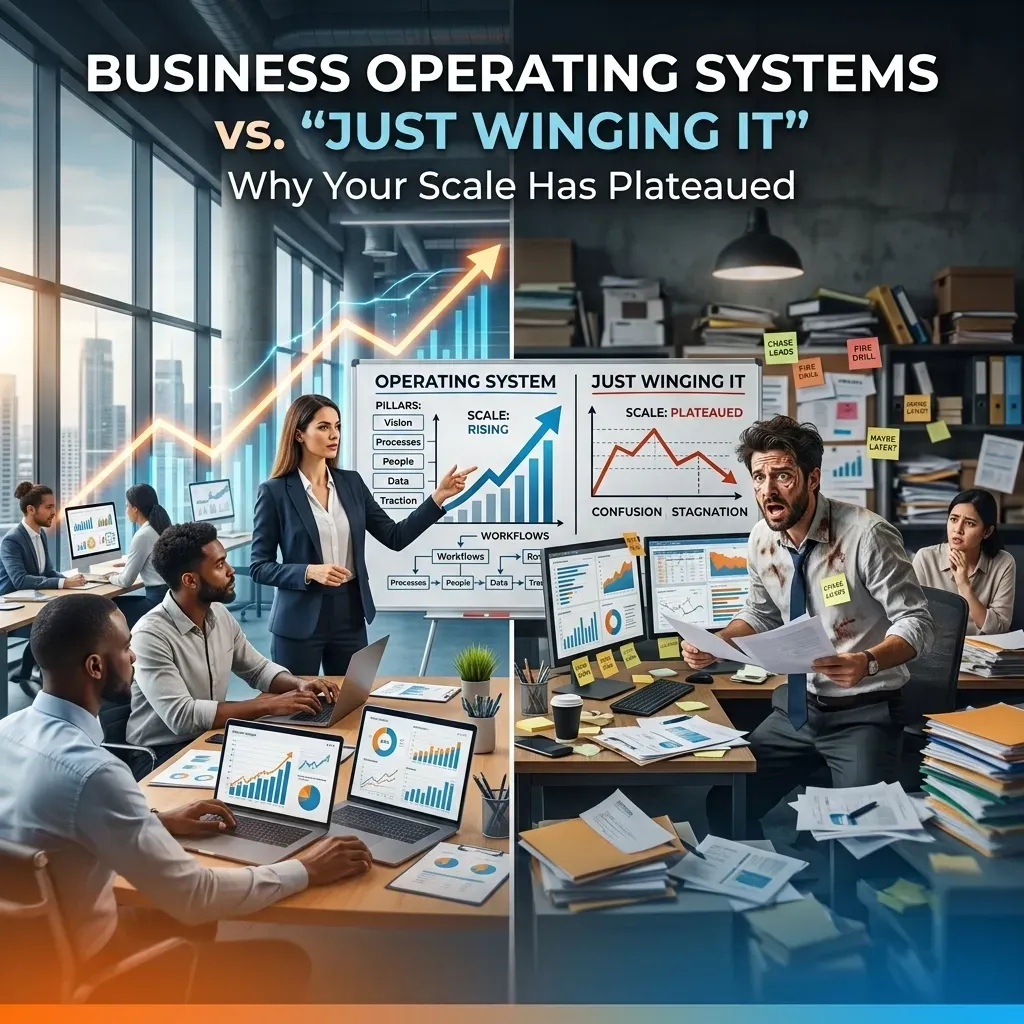
Business Operating Systems vs. "Just Winging It": Why Your Scale Has Plateaued
Estimated Read Time: 8 minutes
Do you feel like you’re running a marathon in knee-deep sand?
You’ve built something impressive. You’ve gone from a solo idea to a team of five, maybe ten, or even fifteen people. But lately, the engine is sputtering. Revenue has hit a flat line that no amount of "hustle" seems to fix. Your calendar is a graveyard of back-to-back meetings, and your Slack notifications feel like a physical assault.
The truth is, what got you to seven figures won’t get you to eight. In the early days, "winging it" was your superpower. It made you fast, scrappy, and adaptable. But now? Winging it is the very thing keeping you stuck.
If you feel like you are the bottleneck in your own business, it’s not because you aren’t working hard enough. It’s because you lack a Business Operating System (BOS).
The "Founder’s Trap": Why 3–15 Employees is the Danger Zone
There is a specific kind of chaos that happens when a company grows to between 3 and 15 employees. We call it the "Founder’s Trap."
When you had two employees, you could manage by osmosis. You sat in the same room (or the same Zoom), and they just knew what you were thinking. But as the team grows, communication lines don't just add up, they multiply. Suddenly, you aren't just doing the work; you’re managing the people doing the work, and you’re likely doing a mediocre job at both because you’re spread too thin.
In this stage, most founders fall into "Reactive Mode."
You wake up and check email to see what "fires" need putting out.
You spend your day answering questions like "How do I do this?" or "Where is that file?"
You make every single decision, from high-level strategy to the color of the new landing page.
When you are the center of every workflow, the business can only grow as fast as you can process information. And friend, you are at capacity. This is why your scale has plateaued.

What is a Business Operating System (BOS)?
Think of a BOS as the "Windows" or "macOS" for your company. It’s not a piece of software (though software can help run it); it’s the consistent way your business functions. It defines how you set goals, how you communicate, how you run meetings, and how you hold people accountable.
At OPS Framework, we believe that when you move from "winging it" to a structured system, Success is Certain. It moves the weight of the business off your shoulders and onto the system.
A robust BOS answers three fundamental questions for every person on your team:
What are we trying to achieve? (Alignment)
How do we do it? (Process)
How do we know if we’re winning? (Data)
A.I.M. to Win: The Bridge Between Chaos and Scale
During my keynote, "A.I.M. to Win," I talk about the three pillars that transform a reactive business into a proactive growth engine. If you want to break through your current plateau, you need to master these three phases: Action Plan, Implement, and Measure.
1. Action Plan: Stop Guessing, Start Mapping
Most founders have a "vision," but they lack an Action Plan. An Action Plan isn't a 50-page document gathering dust in a Google Drive folder. It’s a clear, shared roadmap.
Without a plan, your team is just "busy." They are doing tasks, but those tasks aren't necessarily moving the needle. You need to transition from vague hopes to mastering OKRs (Objectives and Key Results). This gives everyone a North Star. When the plan is clear, the "how" becomes much easier to delegate.
2. Implement: Building the Machine
Implementation is where most "wingers" fail. They have a great idea, they tell the team, and then they move on to the next shiny object. A Business Operating System forces disciplined implementation.
This means creating repeatable processes. If a task has to be done more than twice, it needs a system. By implementing a standardized way of working, you reduce the "cognitive load" on your team. They no longer have to ask you for permission or guidance every five minutes because the "OPS way" is documented and accessible.

3. Measure: Data Over Drama
How do you feel about your business right now? Most plateaued founders lead by "feel."
"I feel like marketing is doing okay."
"I feel like we’re losing money on this project."
Drama lives in the space where data is missing. To scale, you must move to a culture of measurement. You need a scorecard of 5–15 high-level numbers that tell you exactly how the business is performing. When you Measure, you can catch a plateau before it becomes a decline. You stop managing people’s personalities and start managing the numbers.
The Performance Gap: The Real Cost of Winging It
Research shows that businesses with a standardized operating system achieve 20–30% higher productivity. Why? Because they stop wasting time on "work about work."
When you don't have a BOS:
Decisions stall: Everything waits for the founder’s approval.
Duplicate work: Two people spend three hours on the same task because roles aren't clear.
Talent leaves: Your best people get frustrated by the lack of clarity and the constant "pivot-itis" of a reactive founder.
When you implement the OPS Framework, you aren't just organized; you are scalable. You create a business that can run without you. Imagine taking a two-week vacation without checking your phone once, and coming back to find the business grew while you were gone. That’s not a dream, that’s the result of a system.

How to Start Building Your System Today (Best Practices)
If you’re ready to stop winging it, don't try to change everything overnight. That’s a recipe for burnout. Follow this step-by-step "Quick-Start" guide:
Step 1: Audit Your Time
For one week, track every time a team member interrupts you with a question. Categorize these questions. Are they asking about a process? A policy? A decision? This list is your roadmap for what needs to be systematized first.
Step 2: Define Your Top 3 Objectives
Stop trying to do 50 things. Use our OKR workbook to narrow your focus down to the three things that will actually break the plateau.
Step 3: Create a "Standard Meeting Pulse"
Stop the ad-hoc "Hey, do you have a sec?" meetings. They kill productivity. Implement a weekly Leadership Meeting with a fixed agenda: Review big goals, check key metrics, and solve the biggest bottlenecks.
Step 4: Empower a "Process Owner"
You shouldn't be the one writing all the SOPs. Identify someone on your team who is naturally organized and make them the "Keeper of the System." If you don't have that person, it might be time to look into a Fractional COO.

Overcoming the "But We’re Special" Barrier
The biggest objection I hear from founders is: "Chris, my business is too creative/complex/unique for a rigid system. A BOS will kill our culture."
I get it. You don't want to turn into a cold, corporate cubicle farm. But here’s the secret: Structure creates freedom.
When the routine things are handled by a system, your team has more mental energy for creativity and innovation. You aren't killing your culture; you’re saving it from the stress of constant chaos. A Business Operating System is the "glue" that keeps your team together as you grow.
Your Path to Certain Success
The plateau you are sitting on right now is a signal. It’s your business telling you that the current version of "you" and your processes have reached their limit. To get to the next level, you have to evolve.
You can keep winging it, hoping that next month’s sales will somehow feel different. Or, you can choose to build a foundation that makes growth inevitable.
At OPS Framework, we specialize in helping founders transition from "Chief Everything Officer" to a true visionary leader. We provide the tools, the fractional leadership, and the proven 3-step reset for smarter growth to help you reclaim your time and scale your impact.
Ready to see how the A.I.M. framework can work for you? Let's get you out of the bottleneck and back into the driver's seat.
Book a Connection Call with us today and let's start building your engine for scale.
Ready to dive deeper into operational excellence? Check out our latest guide on implementing OKRs in your business or explore our About page to learn more about the OPS philosophy.