Your Quick-Start Guide to Operational Efficiency: Process Before Software
Estimated Read Time: 9 minutes
Do you ever feel like you’re drowning in a sea of "solutions" that only seem to create more problems? You’ve got Slack for communication, Asana for tasks, HubSpot for sales, and a dozen other tabs open: yet your team is still asking, "Who’s doing what?" and "Where is that file?"
This is the reality of Operational Chaos. It’s the feeling of being the bottleneck in your own company, despite having a tech stack that should, theoretically, make you a productivity god.
At OPS Framework, we see this every day. Most founders and leaders we work with suffer from a specific "technographic" profile: you have the basic tools, but you lack an optimized stack. You’ve bought the software, but you haven’t designed the system.
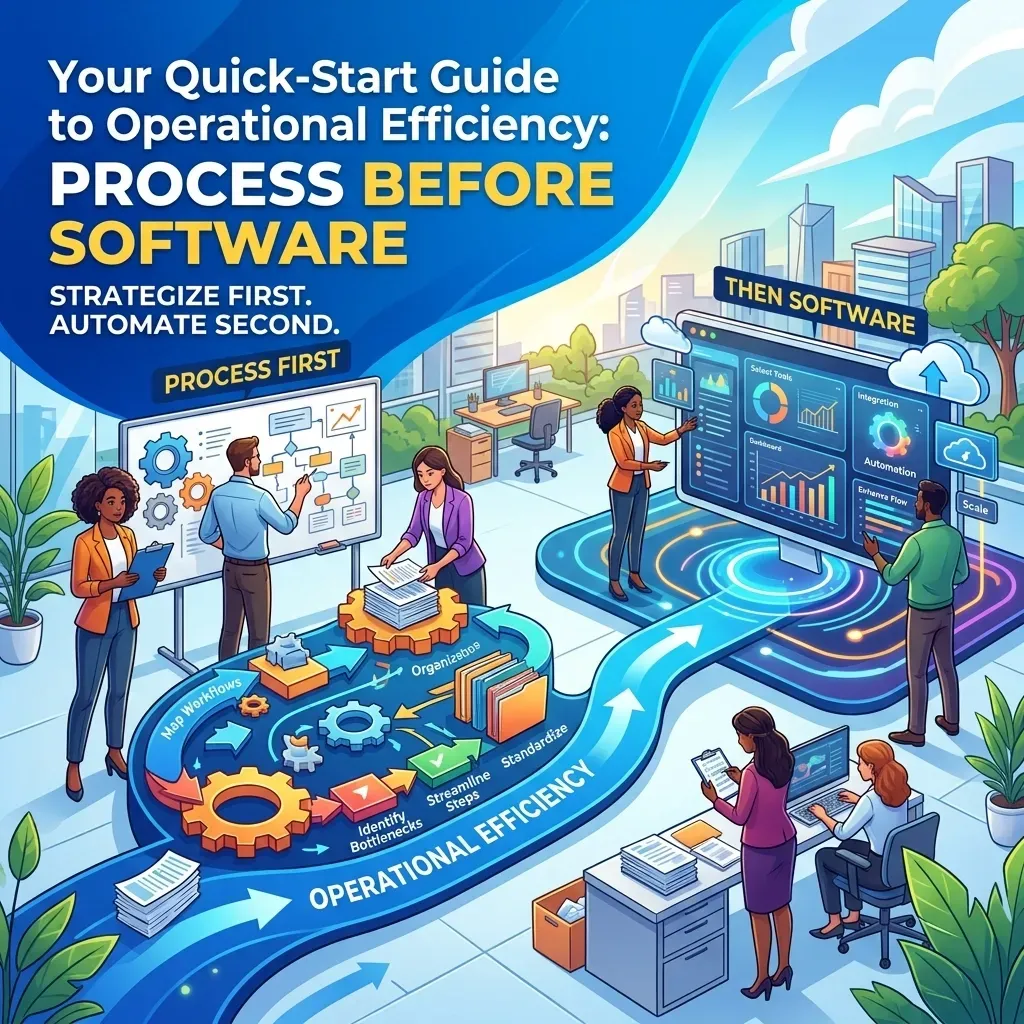
Here is the hard truth: Software is an accelerator, not a savior. If you automate a broken process, you just create a broken process that happens at 10x speed. If you want to scale without losing your mind, you must adopt the mantra of Process Before Software.
In this guide, we’re going to walk through the OPS Framework approach to systems design. We’ll show you how to strip back the noise, fix the underlying mechanics of your business, and build a foundation where Success is Certain.
The Trap of the "Magic App"
Why do we instinctively reach for a credit card when a process feels clunky?
We’ve been conditioned to believe that there is an app for everything. Feeling disorganized? Get Notion. Need better data? Get a more expensive CRM. But tools are just "digital containers." If you don’t know how the work flows from point A to point B, the container doesn’t matter.
When we focus on software first, we ignore the Systems Design: the logic, the handoffs, and the human accountability that actually drive results. We’re going to flip that script.

Step 1: Map Your Current Reality
How can you optimize what you can’t see?
Before you touch a single line of code or a settings menu, you need to map out how work actually moves through your organization. This isn't about how it should work; it’s about the messy, real-world path a project takes from lead to delivery.
Audit your workflows: List every major function (Sales, Onboarding, Fulfillment, Billing).
Identify the handoffs: Where does information pass from one person to another? This is usually where the balls get dropped.
The "Shadow" Work: Note the manual "fixes" your team does every day: the spreadsheets used to track what should be in the CRM, or the repetitive DM’s to check status.
Mapping provides the baseline. It reveals the waste. Without this map, you’re just wandering in the woods with a very expensive compass.
Step 2: Record Your Metrics and Benchmarks
What does "efficiency" actually look like for you?
You can’t improve what you don’t measure. We need to establish the "input vs. output" ratio. If you spend 40 hours of labor to generate $1,000 in revenue, that’s your baseline.
Focus on:
Cycle Time: How long does it take to complete a core process?
Defect Rate: How often do things go wrong or need to be redone?
Labor Cost: What is the actual human cost of running the status quo?
By recording these numbers now, you create the ROI case for the changes you’re about to make. You can see our 3-step reset for smarter growth to help identify where these leaks are happening.
Step 3: Identify the "Process Offenders"
Now that you have your map and your metrics, it’s time to find the friction.
Look for the "Process Offenders": the workflows that drain time and energy without adding value. These are usually non-billable tasks, repeated manual data entry, or administrative hurdles that exist "because we’ve always done it that way."
Ask yourself:
"If I removed this step, would the customer notice?"
"Is this step here to provide value, or just to cover up a lack of trust?"

Step 4: Align with OKRs (Objectives and Key Results)
Operational efficiency is meaningless if it isn't moving you toward a goal.
This is where we align your daily "grind" with your strategic "vision." We use OKRs to ensure that every process we refine serves a greater purpose. For example, an Objective might be "World-Class Customer Onboarding," and the Key Result might be "Reduce onboarding time from 10 days to 2 days."
Now, every process change has a "Why." If you're struggling to bridge the gap between strategy and execution, check out our post on implementing OKRs in your business.
Step 5: Refine and Standardize (The "SOP" Phase)
Standardization is the "glue" that holds growth together.
Once you’ve identified a better way to work, you must document it. Create Standard Operating Procedures (SOPs) that are clear enough for a new hire to follow without a three-hour training session.
A good SOP should define:
What: The task name.
Why: Why this task matters.
How: The step-by-step execution.
Definition of Done: How do we know it’s finished and correct?
Standardization reduces decision fatigue. It transforms your team from "problem solvers" into "system executors."
Step 6: Empower the Team
Your processes are only as good as the people running them.
Communication is the "lifeblood" of this transition. You need to foster a culture where your team feels empowered to point out where the system is failing. They are on the front lines; they know where the friction is.
Instead of dictating processes from the top down, involve them in the design. When people help build the system, they take ownership of its success.

Step 7: Leverage Technology and Automation
Finally. We’ve arrived at the software.
Now that you have a documented, tested, and manual process that actually works, you can look for tools to automate the repetitive parts.
The Integration Rule: Only add software that "talks" to your existing stack. Don't create more data silos.
Automation: Use tools like Zapier or Make to move data between apps so your team doesn't have to.
The CRM/ERP: Ensure your core system of record reflects your new, optimized workflows.
This is where we transform your "basic tech" into an "optimized stack." You’re no longer buying a tool and hoping it fixes your business; you’re buying a tool to fuel a machine you’ve already built.
Step 8: Track, Iterate, and Scale
Efficiency is not a destination; it’s a rhythm.
Set a cadence: monthly or quarterly: to review your metrics. Did your cycle time decrease? Did your profit margins expand? If not, go back to Step 1.
Business is dynamic. Your processes must be too. By constantly iterating, you ensure that you never slide back into Operational Chaos.
Common Pitfalls to Avoid
The "Shiny Object" Syndrome: Don't get distracted by the latest AI tool if your basic communication is broken.
Over-Engineering: Don't build a 50-step process for a task that takes 5 minutes. Keep it as simple as possible, but no simpler.
Ignoring the Human Element: If your team hates the process, they will find ways to bypass it. Listen to their feedback.
Unlock Your Growth Engine
The shift from "Software First" to "Process First" is the difference between a business that survives and a business that thrives. It’s the core of the OPS Framework services: designing systems that empower leaders to step out of the weeds and into their zone of genius.
When your processes are lean and your team is aligned, the chaos subsides. You stop reacting to fires and start building the future. This is how you transform your business into a high-performance engine where Success is Certain.
Ready to stop the chaos?
If you're tired of being the bottleneck and want a clear path to operational excellence, let's talk. We can help you design the systems you need to scale without the stress.