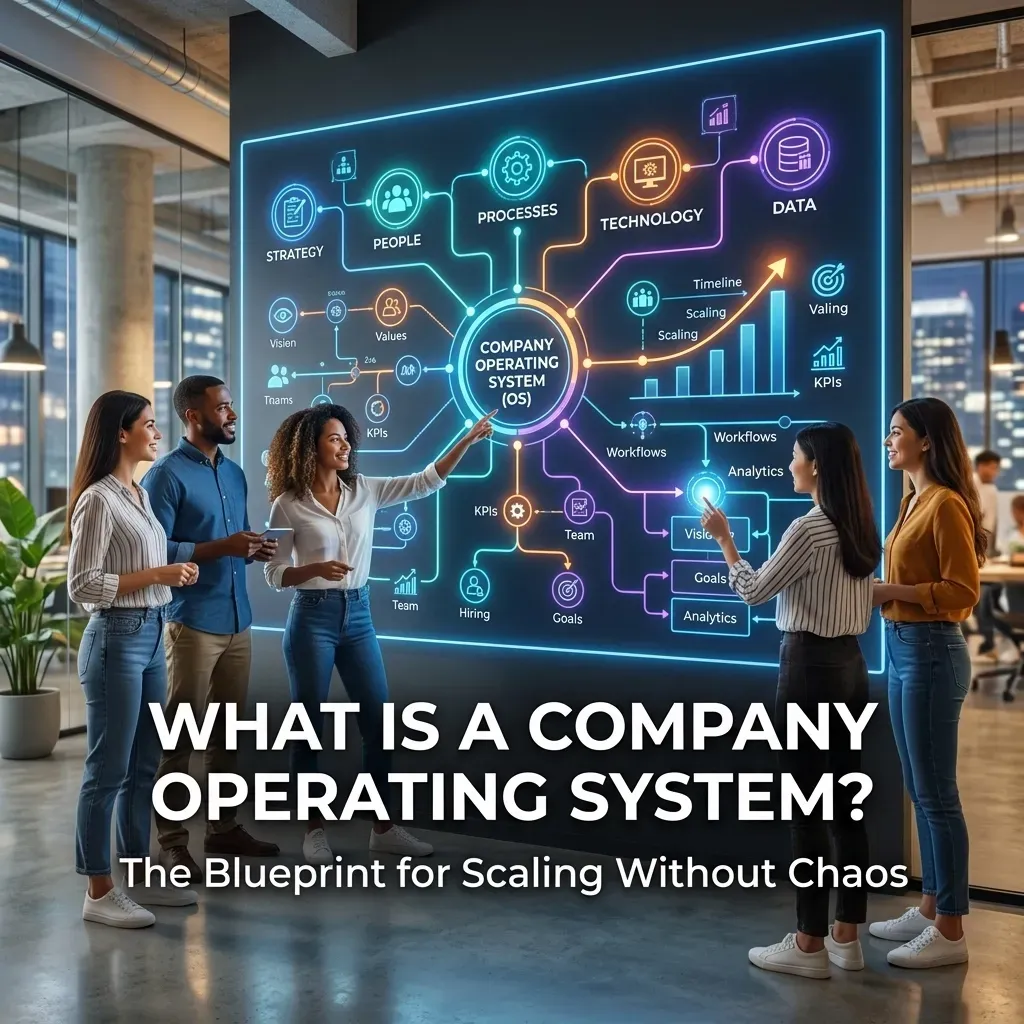
What is a Company Operating System? The Blueprint for Scaling Without Chaos
Estimated Read Time: 8 Minutes
Do you feel like your business is growing, but your sanity is shrinking?
It’s a common paradox for founders and high-growth teams. You hit that sweet spot of market demand, your team expands from five to twenty-five, and suddenly, the wheels start to wobble. Communication breaks down, deadlines are missed, and you: the leader: find yourself stuck in the "Founder’s Trap," acting as the ultimate bottleneck for every single decision.
Growth is supposed to be the goal, but without a foundation, growth simply adds people, and complexity adds chaos.
If you’re tired of firefighting and ready to build a business that runs as a high-performance machine, you don’t just need more staff or better software. You need a Company Operating System (OS).
In this playbook, we’re going to define exactly what a Company OS is, why it’s the secret sauce for scaling without burnout, and how you can use the A.I.M. to Win framework to build yours.
What Exactly is a Company Operating System?
Think of your favorite smartphone. It has hardware (the screen, the battery, the chips) and it has apps (Instagram, Email, Slack). But neither of those things works without the iOS or Android software sitting in the middle. That software: the Operating System: is what tells the hardware how to behave and provides the environment for the apps to run.
A Company Operating System is the intentional architecture of your business. It is the interconnected set of processes, rhythms, and cultural norms that dictate how your team plans, executes, and communicates.
It isn’t just a "manual" sitting on a shelf. It’s the "central nervous system" of your organization. It’s the invisible logic that ensures:
Strategy is translated into daily action.
Data informs every major decision.
People know exactly what is expected of them without being told twice.
Without a deliberate OS, your company develops one by accident. And an "accidental" operating system is usually built on tribal knowledge, messy Slack threads, and the heroics of a few overworked individuals.
The Distinction: OS vs. OKRs vs. SOPs
A common point of confusion we see at OPS Framework is leaders thinking they have an operating system because they have a list of SOPs or they just started using OKRs.
Let’s clear the air. These are components of a system, not the system itself.
1. SOPs (Standard Operating Procedures)
SOPs are the "How-To" manuals. They tell a team member how to onboard a client or how to run a weekly report. They are vital for consistency, but they are tactical. An SOP tells you how to change a tire; a Company OS tells you where the car is going and how fast it should be moving.
2. OKRs (Objectives & Key Results)
OKRs are a goal-setting framework. They help you define "Where are we going?" and "How will we know we’re there?" They provide focus and alignment. However, you can have the best OKRs in the world, but if your team doesn't have a rhythm for meeting or a system for tracking progress, those OKRs will just be words on a spreadsheet. (Check out our Mastering OKRs post for a deeper dive here).
3. The Company OS
The OS is the Engine. It’s what connects the SOPs (the parts) to the OKRs (the destination). It includes your meeting rhythms, your reporting dashboards, your decision-making protocols, and your strategic planning cycles.
The OS is the glue that makes the individual parts stick together and move in the same direction.
Why a Company OS Matters for High-Growth Teams
If you are a team of three people in a garage, you don’t need a complex OS. You can just talk across the desk. But as you scale, the "communication tax" begins to eat your profits.
Here is why a defined OS is non-negotiable for scaling:
Eliminating the Founder Bottleneck: When the system holds the logic, you don't have to. You can step away for a week (or a month) and the "machine" keeps humming because the rules of engagement are clear.
Scaling Without Chaos: Growth adds complexity. An OS simplifies that complexity by providing repeatable patterns. You stop reinventing the wheel every time you hire a new person or launch a new product.
Clarity and Autonomy: High-performers hate being micromanaged. They love clarity. A Company OS provides the guardrails within which your team can run fast and make their own decisions.
Predictability: It moves you from "reactive" (firefighting) to "proactive" (planning). You start measuring what matters before it becomes a crisis.
Building Your OS: The A.I.M. to Win Framework
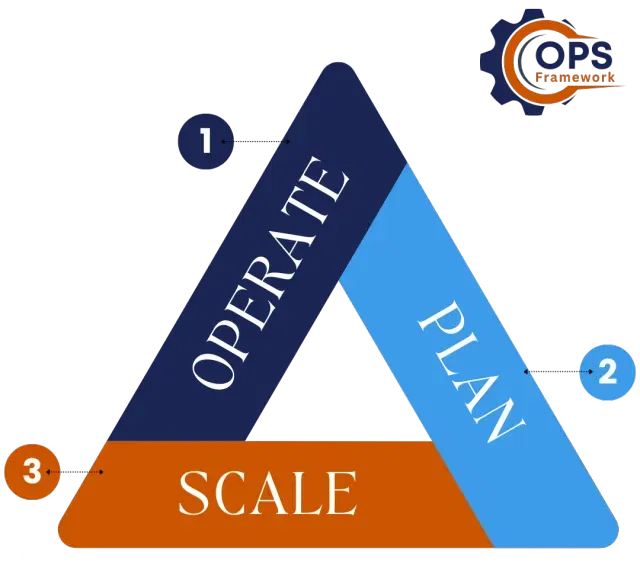
At OPS Framework, we believe in keeping things practical. To build or optimize your business scaling strategies, we use the A.I.M. to Win framework: Action Plan, Implement, and Measure.
Phase 1: Action Plan (The Blueprint)
You can’t build a house without a blueprint. In this phase, you define the "rules of the game."
Identify the Core Process: What is the 20% of activities that drive 80% of your results?
Set the Strategy: Define your North Star and your one-year goals.
Establish the Rhythm: Decide how often you will meet. Is it a 10-minute daily stand-up? A 90-minute weekly tactical? A quarterly strategic offsite?
Phase 2: Implement (The Execution)
This is where the rubber meets the road. It’s about process optimization and getting the team onboard.
Standardize the Tools: Stop using five different project management tools. Pick one and stick to it.
Document the Flow: Map out how information moves from sales to operations to finance.
Build the "Playbook": Create a central "Source of Truth" (like a Wiki or Notion space) where the OS lives.

Phase 3: Measure (The Optimization)
A system that isn't measured eventually breaks.
Scorecards: Every leader should have 3–5 "leading indicators" they track weekly.
Feedback Loops: Schedule regular retrospectives to ask: "What’s working in our system, and what’s creating friction?"
Iterate: Your OS should evolve as you scale. What worked for a team of 10 won't work for a team of 50.
Common Pitfalls to Avoid
Even with the best intentions, building a Company OS can go sideways. Here’s what to watch out for:
Over-Engineering: Don't try to document every single breath your employees take. Start with the "Critical Path": the things that, if they fail, the business stops.
Setting and Forgetting: An OS is a living organism. If you don't use it in your daily meetings, it becomes "shelfware."
Ignoring the Human Element: Systems are run by people. If your team doesn't understand why the system exists (to make their lives easier, not harder), they will resist it.

Best Practices for Getting Started
Ready to stop the chaos? Follow these steps to begin implementing your own Company OS:
Conduct an Audit: Ask your team, "Where is the most friction in our day-to-day work?" That is where your system is failing. Try our Bottleneck Assessment to find the leaks.
Start with Meetings: The easiest way to install an OS is to fix your meeting pulse. Move from "random check-ins" to a structured weekly cadence with a fixed agenda.
Define One Key Metric: Pick one number that tells you if the business is healthy today. Track it religiously.
Empower a "Systems Champion": Whether it's an Operations Manager or a Fractional COO, someone needs to own the integrity of the system.
Transform Your Business Into a Growth Engine
A Company Operating System isn't a luxury: it’s the fundamental requirement for any leader who wants to scale without losing their mind. It transforms your business from a collection of individuals into a unified, high-performance team.
Remember, you don't rise to the level of your goals; you fall to the level of your systems. By applying the A.I.M. to Win framework, you are not just working in your business; you are building a machine that empowers you to work on it.
Are you ready to stop the firefighting and start scaling?
If you're feeling overwhelmed by the complexity of growth, let’s talk. We help high-growth teams design and implement the custom operating systems they need to reach the next level.
👉 Book a Connection Call today and let's build your blueprint for scaling without chaos.