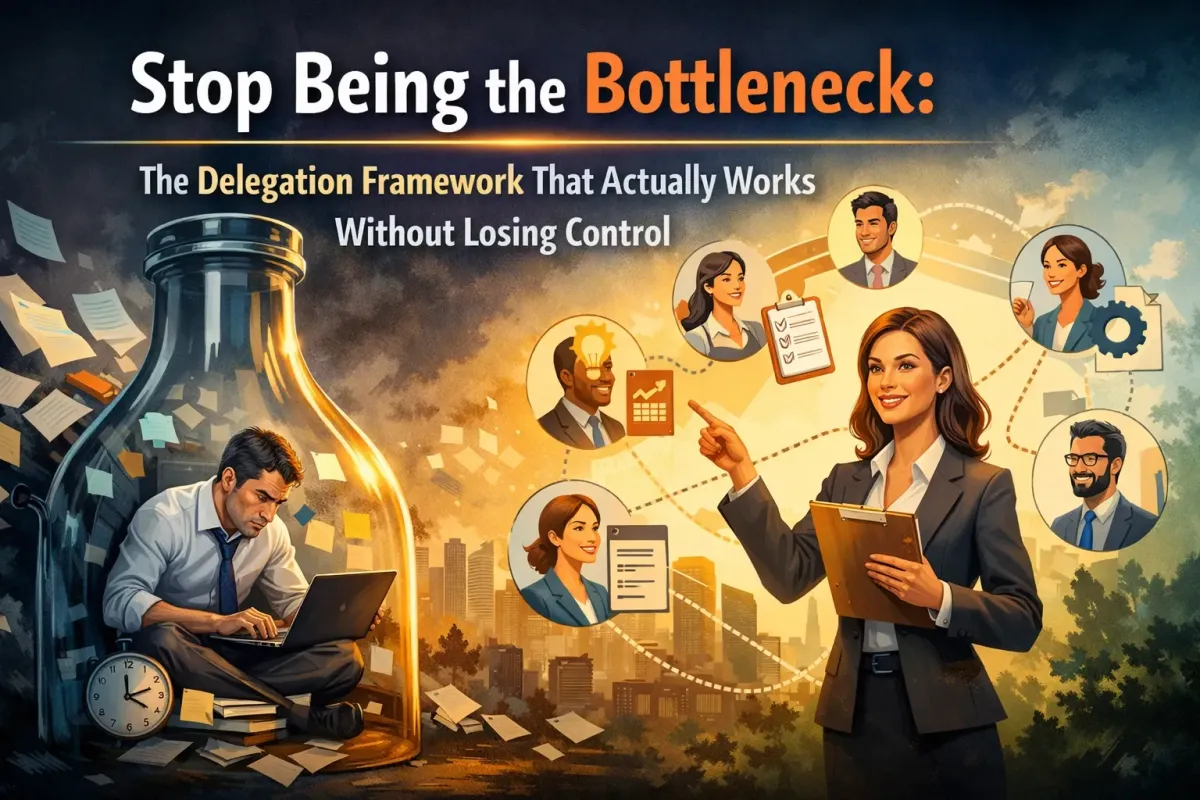
Stop Being the Bottleneck: The Delegation Framework That Actually Works Without Losing Control
Estimated Read Time: 7 minutes
Does your business grind to a halt the moment you step away for a cup of coffee?
If you’re a CEO or founder of a $2M to $20M company, you’ve likely felt the weight of every single decision resting on your shoulders. You’ve built something incredible, but now you’re the very thing standing in the way of its next stage of growth. You’re the "Genius with a Thousand Helpers," and quite frankly, you’re exhausted.
We see it all the time at OPS Framework. You want to scale, but every time you try to delegate, the quality drops, things get missed, or you end up doing the work yourself anyway "just to get it done right." This isn't just a personnel issue; it’s a systems failure.
To break free, you don't need to work harder. You need a better way to operate.
The Ghost in the Machine: Why You’re Still Doing Everything
Most leaders treat delegation like a hand-off in a relay race. They drop the baton, hope the other person catches it, and then scream from the sidelines when they don't. When that fails, they revert to "clutching": holding onto every micro-decision because it feels safer than the chaos of letting go.
But here is the hard truth: If you are the only one who can make a decision, you don't own a business; you own a high-stress job.
The cost of being the bottleneck is astronomical. It’s not just the leadership burnout solutions you're searching for at 2 AM. It’s the missed $500k contracts because you didn't have the capacity to review the proposal. It’s the "A-Players" on your team leaving because they’re tired of waiting for your approval to do the jobs you hired them for.

The C.H.R.I.S. Mindset: Your New Operational North Star
At OPS Framework, we believe that operational excellence starts with a shift in perspective. We call this the C.H.R.I.S. Mindset. Before you can fix your delegation, you have to fix the framework through which you view your role as a leader.
Clarity: Does everyone know exactly where we are going and what "good" looks like?
Habits: Are your daily actions supporting growth or creating drag?
Rhythm: Do you have a consistent cadence for communication and reviews?
Integrity: Do your systems actually do what you say they will do?
Systems: Is the process documented so it can survive without you?
When you apply this mindset, delegation stops being a "chore" and starts being a strategic business scaling strategy. You stop managing people and start managing the system that manages the people.
Outcome-Based Delegation: Stop Giving Instructions, Start Giving Ownership
The biggest mistake leaders make is delegating tasks instead of outcomes.
When you delegate a task (e.g., "Post this on LinkedIn"), you retain the mental load of the process. You have to check if it was done, how it looked, and if the caption was right. When you delegate an outcome (e.g., "Own our LinkedIn presence to generate 5 leads a month"), you transfer the responsibility for the how to your team member.
What is Outcome-Based Delegation?
It is the process of defining the destination while letting your team choose the route. You are responsible for the "What" and the "Why." They are responsible for the "How."
How to implement it:
Define Success: What does a "win" look like for this project? Be specific.
Set Constraints: What are the non-negotiables? (Budget, brand voice, legal requirements).
Transfer Authority: Give them the power to make decisions within those constraints without calling you.
By shifting to outcomes, you empower your team. Employees who feel trusted and have clear ownership are significantly more engaged and productive. You aren't losing control; you are gaining clarity.
The 10-60-90 Rule: How to Stay Informed Without Micromanaging
"But Chris," you might say, "If I don't check in, how do I know they aren't driving the car off a cliff?"
This is where most delegation fails. You either hover (micromanaging) or you vanish (abdication). Neither works. Instead, we use the 10-60-90 Rule. This is the lifeblood of effective teamwork strategies.
The 10% Mark: Meet at the very beginning. Ensure they understand the outcome, the constraints, and the resources. This is where you align the vision.
The 60% Mark: Check in when the "ugly first draft" is done. Is the logic sound? Are they headed in the right direction? It’s much easier to course-correct at 60% than at 99%.
The 90% Mark: The final polish. You provide the "CEO magic" here: those small tweaks that elevate the work from good to great.
This rhythm ensures you are a resource, not a roadblock.

Building Your Decision-Making Authority Matrix
One of the fastest ways to stop being the bottleneck is to clarify who can decide what. We often find that teams want to take work off the CEO's plate, but they are terrified of making a mistake.
You need to create a simple matrix that categorizes decisions:
Solo Decisions: The team member makes the call and doesn't even need to tell you.
Consult Decisions: The team member makes the call but must inform you afterward.
Consensus Decisions: You and the team member decide together.
CEO Decisions: You make the call (this should be reserved for high-stakes, vision-level moves).
As you scale, your goal is to push as many decisions as possible into the "Solo" and "Consult" categories. If you're still curious about how to align these decisions with long-term goals, mastering OKRs is a great next step.
Common Pitfalls: Why "Different" Isn't "Wrong"
As an expert who likely built this company from the ground up, you have a specific way of doing things. When you delegate, your team will do it differently.
The Trap: Seeing a different process as an inferior result.
The Fix: Focus on the outcome. If the goal was to get to the airport and they took a different highway than you would have, but they arrived safely and on time: that is a win.
Stop correcting the "how" if the "what" meets your standard of excellence. This is the only way to unlock business potential across your entire organization.

The Roadmap to Reclaiming Your Life
If you’re ready to stop being the bottleneck and start being the visionary leader your company needs, you have to stop treating operations like an afterthought. You need to install a "Growth Engine" that works while you sleep.
Audit Your Time: Identify the tasks that "Only You" can do versus the tasks that are "Delegate Now."
Document the Outcome: Stop giving verbal instructions. Use a simple template to define the win.
Install the Cadence: Start using the 10-60-90 rule this week on just one project.
The journey from overwhelmed operator to orchestrating owner isn't overnight, but it is inevitable if you follow a proven framework.
Take the Next Step
You’ve spent years building your business. Don't let a lack of systems be the thing that burns it: or you: down. Whether you need a full Fractional COO Playbook or just a quick reset to find your footing, we are here to help.
Ready to get out of the weeds?
Download our guide: Stop Being the Bottleneck and get the exact worksheets we use with our high-growth clients.
Book a Free Clarity Call: Let’s look at your current operations and identify exactly where the clogs are. Schedule your call here.
You have the vision. Let’s build the framework to make it a reality.