
CEO Burnout Isn't a Motivation Problem - It's a Systems Problem
How the C.H.R.I.S. Framework Fixes Both
By Chris Monroe, Founder of OPS Framework
If you're burned out as a CEO, it's not because you're lazy, unmotivated, or losing your edge.
It's because your systems are demanding heroics instead of leadership.
You've heard the advice. Take more time off. Delegate better. Work on your mindset. Reconnect to your why. Maybe you've even tried it. You took a vacation, came back refreshed, and within 72 hours, you were right back where you started. Overwhelmed. Exhausted. Running on fumes.
Here's what nobody tells you: burnout isn't a personal failure. It's an operational signal that the business is misaligned.
The lie you've been sold is that you need more grit, more discipline, more hustle. One more push and you'll break through. But high performers don't burn out from lack of motivation. They burn out when clarity, structure, and rhythm break down.
71% of CEOs report experiencing burnout, with many citing the constant pressure of decision-making and operational overload as primary drivers. The cost isn't just personal. Each burned-out executive costs organizations an average of $20,683 in lost productivity, poor decision-making, and turnover ripple effects.
This isn't about working harder. It's about building better systems. And that's exactly what this article shows you how to do.
Why Traditional Burnout Advice Fails CEOs
Let's talk about the advice you've already heard.
Take time off. Rest. Recharge. Come back with fresh energy.
Delegate more. Stop doing everything yourself. Trust your team.
Work on your mindset. Journal. Meditate. Get clear on your values.
Reconnect to your why. Remember why you started this business in the first place.
It's not bad advice. It's incomplete advice.
Here's why it doesn't work long-term: the business still depends on you. While you're on vacation, decisions pile up. Projects stall. Your team waits for direction. And when you return, the stress rebounds immediately because nothing in the underlying structure changed.
You can't recover inside the same system that caused the burnout.
The problem isn't your energy level. The problem is that your business is designed to need you everywhere. Every decision funnels upward. Every problem lands on your desk. Every priority shift requires your approval. You're not leading the business. You're holding it together with sheer force of will.
That's not sustainable. And deep down, you already know it.
Research shows that 68% of executives report their burnout stems from operational dysfunction, not workload alone. It's not about how much you're doing. It's about how the work is structured around you.
Burnout Is a Lagging Indicator of Broken Systems
CEO burnout doesn't appear out of nowhere. It's the end result of structural problems that have been building for months or years.
Burnout shows up when:
Everything routes through the CEO. You're the approval bottleneck for decisions that shouldn't require your input. Your team has learned to wait for you instead of thinking for themselves. Every project needs your sign-off before it can move forward.
Priorities shift constantly. There's no clear operating rhythm. What mattered last week doesn't matter this week. Your team is always reacting, never building momentum. Nothing ever feels finished because the goalposts keep moving.
No clear operating cadence exists. Meetings happen when fires break out, not on a predictable schedule. Planning is reactive. Execution is chaotic. There's no rhythm to stabilize the business.
Decision ownership is unclear. When something needs to be decided, nobody knows who actually owns it. So it defaults to you. Over and over. Until your calendar is full of meetings and your brain is full of other people's problems.
Here's the OPS Framework lens on burnout:
Burnout is the symptom
Bottlenecks are the cause
Systems are the solution
Your energy isn't the problem. Your operating model is.
When the business is designed to funnel everything through you, burnout isn't a failure of discipline. It's the inevitable outcome of a dependency-based structure. You can rest all you want, but until you redesign how decisions get made and work gets done, the exhaustion will return.
The Identity Trap: Why High Performers Stay Stuck
There's another layer to this that most operational advice misses. It's the identity loop that keeps capable leaders locked in burnout patterns.
The hidden identity loop looks like this:
"I'm the one who fixes things."
"They need me."
"I can't let standards slip."
These aren't ego statements. They're internalized beliefs that high-performing leaders develop over years of being the person who makes things work. You've been the one who closes the gap when execution breaks down. You've been the one who steps in when quality drops. You've been the one who solves the problems no one else can solve.
And now your identity is fused to execution instead of direction.
What this creates:
Over-functioning leaders. You're involved in details that should be owned by others. You're solving problems your team should be solving. You're making decisions that don't require your expertise. Not because you're controlling, but because the system has trained everyone (including you) to believe that's what leadership requires.
Under-developed teams. When you're always the answer, your team stops developing their own problem-solving capacity. They escalate instead of deciding. They wait instead of acting. Not because they're incapable, but because they've learned that trying leads to being overridden.
Invisible dependency. The business appears to run, but only because you're holding it together behind the scenes. Remove yourself for a week and everything stalls. That dependency is invisible until you try to step back.
Here's the critical distinction: this isn't ego. It's unstructured leadership.
You're not staying in the weeds because you love control. You're staying in the weeds because there's no system in place to maintain quality without you. Your identity has become wrapped around being the safety net. And that's exhausting.
High performers don't burn out because they lack motivation. They burn out because their identity and their systems are fighting each other. You know you should delegate more, but you don't trust the structure to hold without you being part of the process.
That's where the C.H.R.I.S. Framework comes in.
Introducing the C.H.R.I.S. Framework
The C.H.R.I.S. Framework isn't motivation. It's a leadership operating system.
Most burnout frameworks focus on self-care or mindset shifts. Those matter, but they don't fix the underlying operational problems that cause burnout in the first place. C.H.R.I.S. bridges the gap between mindset and operations. It gives you a structure to lead differently without sacrificing the standards that matter to you.
C.H.R.I.S. stands for:
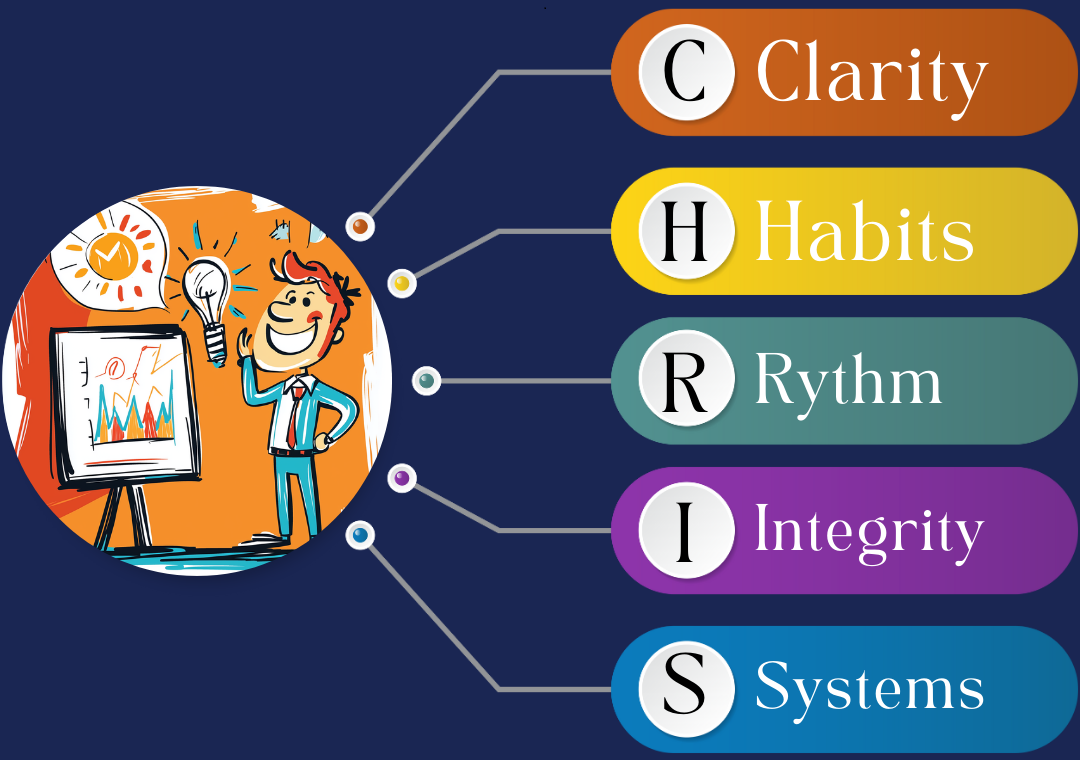
Each element addresses a specific failure point that contributes to CEO burnout. Together, they create a leadership model that removes you from the center of every decision without losing control of quality.
Burnout disappears when identity and systems stop fighting each other.
When your leadership is structured around clarity, rhythm, and systems instead of heroics, you stop needing to be everywhere. Your team knows what success looks like. They know how decisions get made. They know when to escalate and when to execute. And you get to lead from strategy instead of firefighting from the trenches.
Let's break down how each element works.
C.H.R.I.S. Breakdown: How Each Element Reduces Burnout
C: Clarity
What breaks without it:
Constant re-decisions. You make the same decision five different times because there's no documented answer. Your team asks the same questions repeatedly because there's no clear direction. You become the default answer machine because nobody knows what "done well" actually looks like.
Team confusion spreads. People work hard but in different directions. Priorities are assumed, not aligned. Everyone thinks they know what matters, but when you ask three people what the top priority is, you get three different answers.
The CEO becomes the bottleneck by default. Not because you want to be, but because you're the only person with the full picture. Every decision routes through you because nobody else has the clarity to make the call.
What clarity creates:
Defined outcomes. Your team knows what success looks like before they start. They're not guessing. They're not hoping they got it right. They know the standard, the timeline, and the measures that matter.
Decision boundaries. You've made it clear what decisions they can make on their own and what needs to come back to you. This eliminates the constant back-and-forth and gives people confidence to act.
Aligned priorities. Everyone knows what the top three objectives are this quarter. Work is focused. Energy isn't scattered across a dozen competing priorities. The business moves with intention instead of reaction.
Clarity doesn't mean micromanagement. It means people can execute without you because they understand the outcome, the boundaries, and the measures of success.
H: Habits
The real issue:
Most CEOs rely on willpower instead of structure. You tell yourself you'll stop working at 6 PM. You promise yourself you'll take Sundays off. You commit to not checking email after dinner. And then something urgent comes up, and the habit breaks.
Willpower is finite. The structure is renewable.
OPS insight:
Habits replace decision fatigue. When leadership operates on habits instead of heroics, you stop making hundreds of micro-decisions every day. Your brain gets space to think strategically instead of reactively.
Predictable routines reduce cognitive load. When you have a weekly planning rhythm, you're not constantly deciding when to plan. When you have a delegation checkpoint every Friday, you're not wondering if you should check in. The structure handles the decision for you.
Examples of high-impact leadership habits:
Weekly planning cadence. Every Monday morning, you review the week's priorities, align your calendar, and confirm what success looks like by Friday. This one habit eliminates reactive scheduling and keeps you focused on what matters.
Decision review rhythm. Every Friday afternoon, you review the decisions you made that week. Which ones should have been delegated? Which ones shouldn't have required your input? This builds awareness and helps you adjust how decisions flow.
Delegation checkpoints. Once a week, you review what you're still doing that someone else should own. You document it, delegate it, and track whether it stays off your plate. This turns delegation from an intention into a system.
Habits aren't about discipline. They're about designing your leadership so it doesn't depend on your energy level or motivation on any given day.
R: Rhythm
Where burnout accelerates:
No meeting cadence. Meetings happen when fires break out. There's no predictability. Teams don't know when they'll get face time with leadership, so they interrupt constantly.
No execution cycles. Work starts and stops based on urgency instead of importance. Projects launch with excitement and die halfway through because there's no rhythm to maintain momentum.
Always reacting, never stabilizing. You spend your days responding to what's breaking instead of building what's next. There's no space to think because you're always in motion.
Rhythm provides:
Predictability. Your team knows when decisions get made, when priorities get reviewed, and when they'll have access to you. This eliminates the constant interruptions and gives everyone space to focus.
Reduced urgency. When there's a rhythm to how work flows, fewer things feel urgent. People know the planning cycle is coming. They know the review meeting is scheduled. They don't panic because they trust the structure.
Space for strategic thinking. When you're not constantly putting out fires, you have time to think about what's next. You can plan proactively instead of reacting endlessly. That's where breakthrough ideas happen.
Rhythm doesn't mean rigidity. It means your business operates with a cadence that supports execution instead of chaos. You lead from structure, not from urgency.
I: Integrity
Integrity is often misunderstood as morality. In the C.H.R.I.S. Framework, integrity means alignment.
Burnout appears when:
Values don't match daily actions. You say you value strategic thinking, but you spend 90% of your time in execution. You say you value work-life balance, but you're answering emails at 10 PM every night. The gap between what you say matters and what you actually do creates internal conflict.
Leaders say "strategy" but live in execution. You talk about vision, but your calendar is full of tactical work. Your team hears one message but sees another. That misalignment erodes trust and creates confusion about what actually matters.
Vision exists but behavior doesn't support it. You have big goals for where the business is going, but your daily behavior doesn't move you closer to them. You're busy, but not progressing. That disconnect is exhausting.
Integrity restores:
Trust in self. When your actions align with your stated priorities, you stop feeling like a hypocrite. You're living the leadership model you claim to value. That builds confidence and reduces internal friction.
Confidence in leadership. Your team sees that you mean what you say. When you commit to something, it happens. When you set a boundary, it holds. That consistency creates trust and reduces second-guessing.
Sustainable energy. When you're not constantly fighting the gap between what you say and what you do, you stop draining energy on internal conflict. You're moving in one direction, not pulling yourself in five.
Integrity isn't about perfection. It's about closing the gap between intention and execution so your leadership feels coherent instead of chaotic.
S: Systems
Systems are the multiplier that locks everything else in place.
Systems replace:
Memory. You stop relying on what's in your head. Processes are documented. Standards are clear. Your team doesn't need to ask you how something gets done because the system holds the answer.
Heroics. You stop being the person who saves the day. The business runs because the systems work, not because you're constantly intervening. That shift is what makes scaling possible without burnout.
Constant oversight. You're not checking in on every detail because the system includes checkpoints, quality controls, and feedback loops. You trust the structure, not just the people.
What systems enable:
Delegation without loss of control. You can hand off ownership because the system ensures quality. You're not hoping people do it right. You've designed a structure that makes doing it right the default path.
Scale without burnout. As the business grows, complexity doesn't multiply. The systems handle the growth. You're building leverage instead of adding more to your plate.
Leadership instead of firefighting. When systems stabilize execution, you get to focus on where the business is going instead of managing where it is. That's the shift from operator to leader.
Systems aren't bureaucracy, they're freedom. They're what allow you tostop being the bottleneck and start leading the way only a CEO can.
How OPS Framework Turns Burnout Into Leverage
The C.H.R.I.S. Framework is the mindset piece. The OPS Framework is where that mindset becomes operational.
OPS Framework does three things:
Operate: Removes CEO bottlenecks
This is where youstabilize execution and eliminate dependency. You clarify who owns what. You document how decisions get made. You remove yourself from the center of operations so the business can move without waiting for you.
Plan: Aligns goals, roles, and outcomes
This is where you implementOKRs to create clarity across the organization. Everyone knows what success looks like this quarter. Priorities are clear. Roles are defined. Work is aligned to outcomes instead of tasks.
Scale: Builds leaders, not dependency
This is where you create systems that grow with the business. You're not adding more management layers. You're building a structure that develops decision-makers, not order-takers. Your team becomes more capable, not more dependent.
Here's the key distinction:
This isn't therapy. This isn't hustle culture. This is operational leadership design.
Burnout isn't solved by working on your mindset alone. It's solved by redesigning how your business operates so heroics aren't required. The C.H.R.I.S. Framework gives you the leadership model. The OPS Framework gives you the execution structure.
Together, they eliminate burnout at the source.
The Question Every Burned-Out CEO Must Ask
Here's the question that changes everything:
Are you exhausted because you're doing too much, or because the business is structured to need you everywhere?
Most CEOs assume it's the first. They think if they just worked smarter, delegated better, or had more discipline, the burnout would go away. But the real issue is structural.
Your business was built with you at the center. Every process assumes your involvement. Every decision defaults to your judgment. Every project waits for your approval. That's not a personal flaw. That's a design flaw.
And design flaws require design solutions. Burnout is what happens when leadership outgrows its systems.
You've grown as a leader. Your capacity has expanded. Your vision has sharpened. But the operating model of the business hasn't kept pace. It still treats you like the operator instead of the CEO. And that gap is what's burning you out.
The good news? Design flaws can be fixed. You don't need to work harder. You need to build better systems. Systems that remove you from the bottleneck role without sacrificing quality. Systems that create leverage instead of dependency. Systems that let you lead the way only a CEO can.
That's exactly what the OPS Framework is built to do.
Move From Burnout to Operational Clarity
If you're tired of carrying the business on your shoulders, it's time to redesign how it runs.
This isn't about forcing more motivation. This isn't about pushing through. This is about fixing the system so leadership doesn't require heroics.
Here's what happens next:
👉Download the Stop Being the Bottleneck Roadmap and get the exact 3-month plan to remove yourself from daily chaos without losing control of quality.
👉Book a Connection Call and we'll walk through a CEO Bottleneck & Burnout Diagnostic together. We'll map where your systems are breaking, identify the dependencies that are draining your energy, and design a structure that removes you from the center of every decision.
This is an operational clarity session. Not motivational. Not theoretical. We'll talk about how your business actually operates today, where the bottlenecks live, and what needs to change for you to lead without burning out.
You don't need more grit. You need better systems.