
Stop Being the Bottleneck: The Delegation Framework That Actually Works Without Losing Control
If your business stops moving the moment you step away, you're not leading. You're babysitting.
You're working longer hours than ever. Your inbox is a war zone. Your team waits on you for every decision, approval, and answer. And the business you built to create freedom? It's become a prison where you're the warden and the inmate.
Growth was supposed to make things easier. Instead, it made you the bottleneck. Every project needs your sign-off. Every problem lands on your desk. Every question interrupts your focus. You're exhausted, and the business is capped at your capacity.
Here's the truth most business coaches won't tell you: delegation isn't your weakness. Your system is.
You don't need another pep talk about letting go. You need a framework that gives you control and freedom at the same time. That's what this article delivers.
The Real Reason Delegation Fails for Smart Leaders
Let's get one thing straight. You're not struggling with delegation because you're a control freak. You're struggling because there's no system in place to make delegation work.
Most capable founders become bottlenecks for three reasons:
No clear ownership boundaries. When you delegate a task, who actually owns it? Can they make decisions without you? What happens when something goes wrong? Without clear boundaries, delegation becomes a game of telephone where you're still the operator.
No success criteria defined. You hand off work but never define what "done well" looks like. So your team guesses. They deliver something that's 70% of what you wanted. You redo it yourself. And now you've wasted everyone's time and reinforced the belief that it's faster if you just do it yourself.
No feedback or measurement loop. Delegation without follow-up is abdication. But constant check-ins feel like micromanagement. Without a structured feedback loop, you're stuck choosing between hovering or hoping.
Here's the internal dialogue running on repeat in your head:
"It's faster if I do it myself."
"They don't think like I do."
"If I let go, quality will drop."
Those aren't irrational thoughts. They're reasonable concerns when you're trying to delegate without a system. Delegation without structure creates chaos. Control without delegation creates burnout.
The answer isn't to let go. It's to design how control flows through your business instead of through you.
The Hidden Cost of Being the Bottleneck
Let's talk about what this is really costing you. Not just in theory. In reality.
Business Costs:
Slower decision cycles. When every decision requires your approval, speed dies. Opportunities pass while your team waits for you to respond to Slack messages. Competitors move faster because their teams can act without permission.
Team hesitation and dependency. Your team has learned not to think for themselves. Why would they? Every time they try, you course-correct or override. So they wait. They escalate. They become dependent on you for answers they're capable of finding themselves.
Missed opportunities and stalled growth. Growth requires momentum. Momentum requires execution. Execution requires a team that can move without you. When you're the bottleneck, projects stall. Revenue flatlines. And the business you're working so hard to grow stays stuck.
Personal Costs:
Mental overload and decision fatigue. You're making hundreds of micro-decisions every day. By the time you get to the strategic work that actually matters, you're mentally exhausted. Your best thinking happens at 6 AM because it's the only time your brain isn't drowning in other people's problems.
No time for strategy or vision. You started this business because you had a vision. Now you're so deep in the weeds, you can't see the horizon. You spend your days solving problems instead of preventing them. You're managing the present instead of designing the future.
Resentment toward the business you built. You built this to create freedom. Now it owns you. You resent the clients who need you. You resent the team who depends on you. You resent the business that was supposed to give you the life you wanted.
Here's the truth bomb: if everything flows through you, your business is capped at your capacity. You can't scale yourself. And if you don't remove yourself as the bottleneck, you'll hit a ceiling you can't break through.
This is what CEO burnout looks like. And it doesn't get better by working harder.

Why "Letting Go" Is the Wrong Advice
Every leadership article tells you the same thing: let go. Trust your team. Delegate more.
It's terrible advice.
"Letting go" implies abdication. It suggests you step back and hope things work out. That's not leadership. That's negligence.
High-performing leaders don't abdicate. They design control.
There's a massive difference between doing the work and designing how the work gets done. When you do the work, you're the executor. When you design how it gets done, you're the architect.
Here's the shift:
From doing work → to designing how work gets done
From reactive oversight → to intentional delegation systems
From being needed everywhere → to being needed where it matters most
You don't need less control. You need better leverage. You need systems that allow you to maintain quality standards without being involved in every detail. You need a delegation framework that creates consistency, accountability, and results without you hovering.
That's what the next section gives you.
The Delegation Framework That Actually Works
This isn't theory. This is the system business owners use to stop being the bottleneck without losing control of quality.
Step 1: Define the Outcome (Not the Task)
Stop delegating tasks. Start delegating outcomes.
When you tell someone to "update the client report," you're delegating a task. When you tell someone to "ensure the client has full visibility into project progress and next steps by Friday," you're delegating an outcome.
Here's what you need to define:
What "done well" looks like. Be specific. What does success look like? What are the quality standards? What's the format or structure you expect?
Clear success metrics. How will you measure whether this was done well? Is it on-time delivery? Client satisfaction? Accuracy? Define it upfront.
What decisions the owner can make without you. Can they adjust timelines? Spend money? Change the approach? Make it clear where they have autonomy and where they need approval.
When you define outcomes instead of tasks, you give people ownership. You stop micromanaging the how and start holding them accountable for the what.
Step 2: Assign True Ownership
Delegation fails when ownership is unclear.
One owner. Not a committee. Every delegated responsibility needs a single person who owns it. Not a team. Not a group. One person who is accountable for the outcome.
Decision rights clarified. What can they decide on their own? What needs your input? Where's the line? If you don't clarify this, they'll either ask you about everything (bottleneck continues) or make decisions you disagree with (trust erodes).
Authority must match responsibility. If you hold someone accountable for results but don't give them the authority to make decisions, you've set them up to fail. Give them the tools, budget, and decision-making power they need to own the outcome.
Step 3: Create Guardrails, Not Micromanagement
Guardrails protect quality without requiring your oversight.
Here's what guardrails look like:
Non-negotiables. What are the standards that can't be compromised? Budget limits? Brand guidelines? Deadlines? Risk thresholds? Define them clearly so your team knows where the boundaries are.
What must be escalated vs. handled independently. Not everything requires your approval. Define what they can handle on their own and what needs to come back to you.
Where creativity is encouraged. Give people room to solve problems in their own way. If you want innovative solutions, you have to give people the space to experiment.
Guardrails give your team freedom within structure. They know the boundaries. They can move fast. And you maintain control without being involved in every decision.
Step 4: Install a Feedback Loop
Delegation without follow-up is abdication. But constant interruptions kill productivity.
Here's the balance:
Scheduled check-ins, not constant interruptions. Set regular intervals to review progress. Weekly. Biweekly. Monthly. Whatever makes sense for the project. This keeps you informed without turning into a hovering manager.
Review outcomes, not effort. Don't ask how many hours they worked or how busy they were. Ask whether the outcome was achieved. Did they hit the goal? Did it meet the quality standard? That's what matters.
Course correction instead of control. When something's off track, don't take it back. Coach them through the correction. Help them see what went wrong and how to fix it. That's how they grow.
This feedback loop keeps you connected to the work without being buried in it. You stay informed. You maintain quality. And your team builds the skills to execute without you.
How This Fits Inside the OPS Framework
Delegation isn't a personality trait. It's an operational design problem.
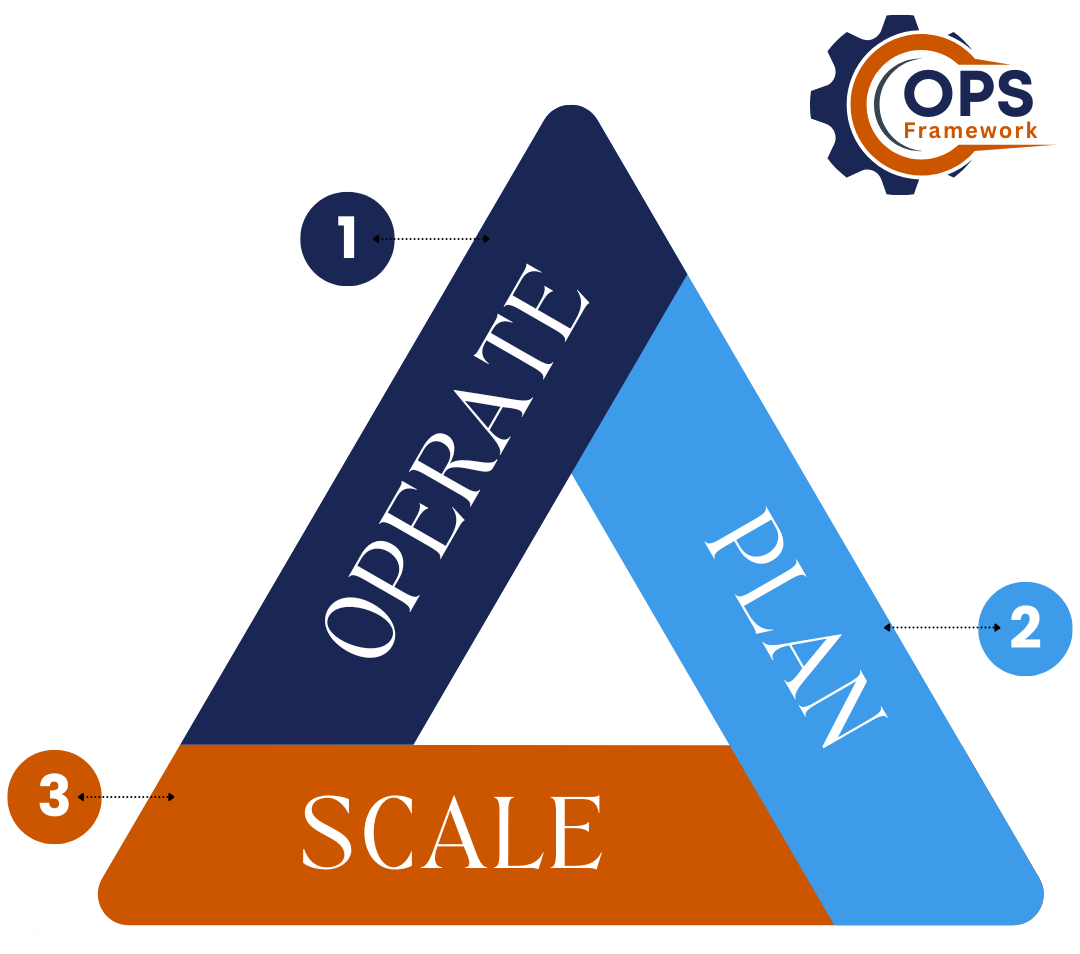
That's why it fits directly into the OPS Framework: Operate. Plan. Scale.
Operate: This is where you stabilize execution. You define roles, clarify ownership, and remove yourself as the decision-making bottleneck. Systems and structure reduce dependency on the founder.
Plan: Delegation works when it's tied to outcomes. That's where OKRs come in. When your team knows what success looks like (objectives) and how it's measured (key results), they can execute without constant oversight.
Scale: Once delegation becomes a system instead of a personality-based approach, it's repeatable. You're not hoping the right person steps up. You're designing a structure that works no matter who's in the role.
Delegation is an operational design problem, not a leadership flaw. When you treat it like a system, it works. When you treat it like a personal weakness, it doesn't.
What Happens When Leaders Stop Being the Bottleneck

Let's talk about what's on the other side of this shift.
Business Outcomes:
Faster execution. Decisions happen in hours, not days. Projects move forward without waiting for your approval. Your business operates at the speed of opportunity, not the speed of your calendar.
Stronger leaders inside the organization. When you delegate well, you build leaders. Your team starts thinking strategically. They solve problems instead of escalating them. They take ownership instead of waiting for direction.
More predictable results. When systems replace heroics, results become consistent. You're not relying on your personal involvement to make things work. The business performs whether you're in the weeds or not.
Personal Outcomes:
Fewer decisions draining mental energy. You stop making a hundred micro-decisions a day. Your brain is freed up for the strategic thinking that actually moves the business forward.
More time in strategy, growth, and vision. You're not managing the present anymore. You're designing the future. You have space to think, plan, and lead at the level the business needs.
Confidence that the business runs without constant intervention. You can step away for a week and the business doesn't fall apart. That's not a luxury. That's what operational maturity looks like.
This is what effective time management for business owners actually means. Not productivity hacks. Not working faster. Building systems that work without you.
The Question Every Leader Must Answer
Are you building a business that depends on you, or a system that works because of how you lead?
There's a difference.
A business that depends on you will always require your presence. A system that works because of how you lead creates leverage. It scales. It grows. And it gives you the freedom you built this business to create.
The goal isn't to be needed everywhere. The goal is to be needed where it matters most.
That shift doesn't happen by accident. It happens when you stop treating delegation like a skill you either have or don't, and start treating it like a system you design.
Move From Insight to Action
If you're ready to stop carrying the entire business on your shoulders, it's time to design a delegation system that gives you control and freedom.
This isn't about letting go and hoping things work out. It's about building the structure that allows your team to execute at the level your business needs.
Here's what happens next:
Book a Connection Call and we'll walk through a bottleneck audit together. We'll map where execution is breaking, identify the delegation gaps that are costing you time and momentum, and design a system that removes you from the center of every decision.
This is a practical, operational conversation. Not motivational. Not theoretical. We'll talk about role clarity, delegation design, and how to install the systems that make your business run without your constant oversight.
You don't need to work harder. You need better systems.
👉 Book Your Connection Call Now
The business you built doesn't have to run on your constant presence. Let's design a delegation framework that actually works.