OKRs 101: How to Align Your Team Without the Corporate Bureaucracy
Estimated Read Time: 9 minutes
Ever feel like your team is rowing in different directions? You’ve got talented people, maybe five, ten, or fifteen of them, but somehow the big-picture projects keep slipping through the cracks. You’re busy putting out fires, and your team is busy "doing work," but at the end of the quarter, you realize you haven’t actually moved the needle on your biggest goals.
If you’re a CEO or founder of a growing business, you’ve probably heard of OKRs (Objectives and Key Results). You might have also heard that they’re what Google and Intel use to dominate the world. And if you’re like most founders I talk to, that sounds like a recipe for a corporate headache you don’t have time for.
You hate bureaucracy. You hate "meetings about meetings." You want agility, not an Excel sheet with 400 tabs.
Here’s the truth: OKRs aren't a complex mystery. They aren't a math problem. They are a decision. Specifically, the decision to stop doing "stuff" and start driving outcomes. At OPS Framework, we believe systems should be the growth engine of your business, not the sand in the gears.
Today, I’m going to show you how to unlock the power of OKRs using our "A.I.M. to Win" system, designed specifically for small, fast-moving teams that want to scale without the red tape.
What Exactly Are OKRs? (The What, Why, and How)
Before we dive into the system, let’s clear the air. What are we actually talking about?
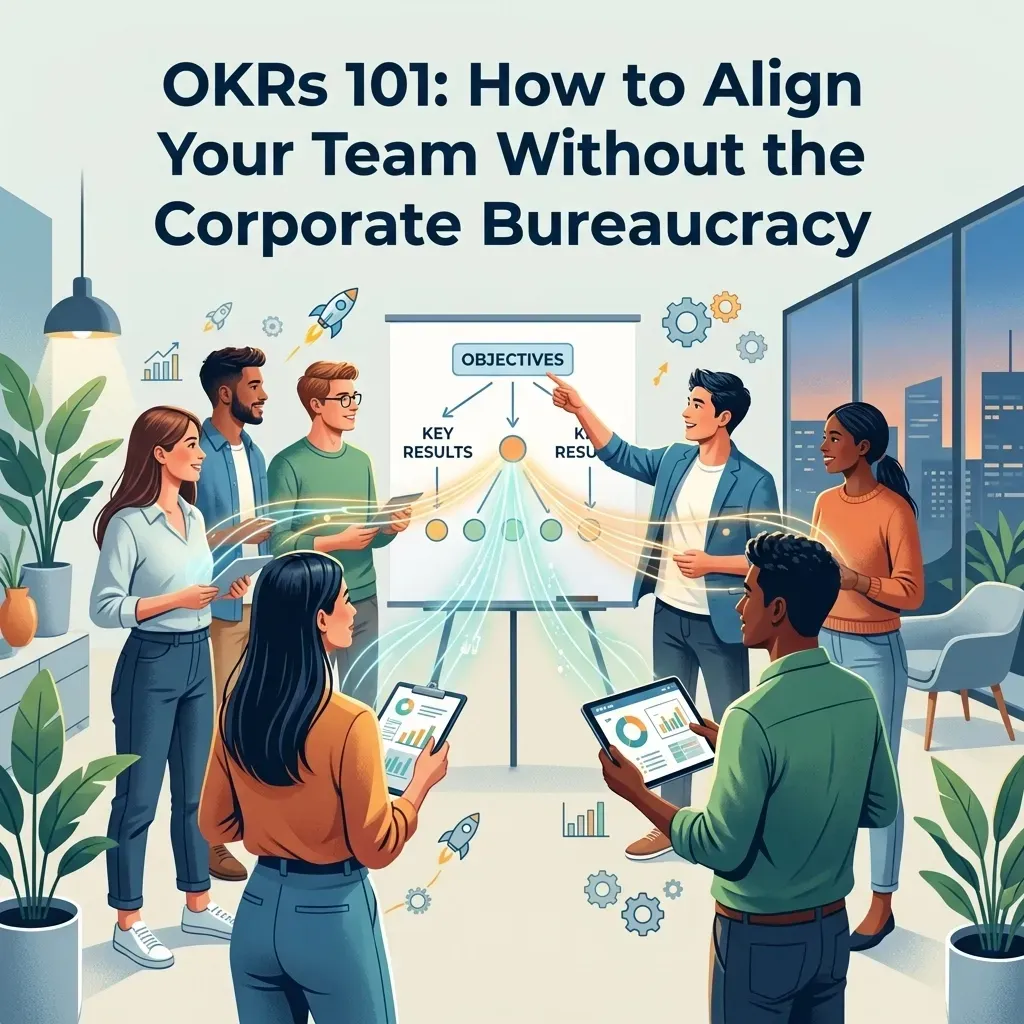
The Objective (The "Where"): This is a qualitative, inspirational goal. It’s the destination on the map. Example: "Become the most responsive consulting firm in our niche."
The Key Results (The "How"): These are quantitative, measurable milestones that tell you if you’ve reached the destination. Example: "Reduce client response time from 24 hours to 4 hours."
Why use them? Because communication is the lifeblood of your company. Without a shared language for success, your team is left guessing.
How do you apply them? You move away from tracking "outputs" (like "write three blog posts") and start tracking "outcomes" (like "increase organic lead generation by 20%").

The "A.I.M. to Win" System
For a team of 3-15 employees, you don't need a heavy HR platform. You need a simple framework to align your vision with their daily actions. We call it A.I.M.: Action Plan, Implement, and Measure.
1. Action Plan: The Decision Phase
The biggest mistake founders make is thinking OKRs are about brainstorming. They aren't. They are about editing.
When you have a small team, you can’t do ten things. You can barely do three things well. The "Action Plan" phase is where you, as the leader, decide what the "North Star" for the next 90 days is.
How to do it:
Identify the Bottleneck: What is the one thing holding your growth back right now? (Hint: If you aren't sure, check out our Bottleneck tool).
Draft the Objective: Make it punchy. It should make your team feel like they’re on a mission, not just filling out a timesheet.
The "Why Now?" Test: Ask yourself, "If we don't achieve this in the next three months, does it matter?" If the answer is "not really," scrap it.
2. Implement: The Ownership Phase
This is where most corporate OKR attempts fail. They "cascade" goals from the top down like a heavy waterfall. In a small team, you want alignment through conversation, not command.
Once you have your top-level Objective, bring it to the team. Don't hand them a finished list of Key Results. Instead, ask them: "Based on this goal, what are the 2-3 things your role can contribute to make this a reality?"
The Implementation Secret:
When people help build the goal, they own the goal. If you want to transform your team from "task-takers" to "problem-solvers," you must empower them to define their own Key Results. This is the glue that holds a high-performing culture together.

3. Measure: The Accountability Phase
If you set OKRs and then wait until the end of the quarter to look at them, you’ve just created a very expensive piece of digital paper.
To "Measure to Win," you need a cadence. For a team of 3-15, we recommend a Bi-Weekly Sync.
Is it on track? (Green/Yellow/Red)
What’s the confidence level? (1-10)
What’s the one blocker?
Keep it short. Keep it focused. Use a simple tracker, or better yet, grab our OKR Workbook to keep it all in one place.
Why OKRs Aren't Bureaucracy (Unless You Make Them That Way)
I hear it all the time: "Chris, I don't want to spend all my time in spreadsheets."
I get it. But here’s the reality: Confusion is the ultimate bureaucracy.
When your team doesn't know what the priority is, they ask you questions all day. They check in constantly. They wait for your approval. That is the red tape that kills your speed. OKRs actually remove bureaucracy by giving everyone a "Commander's Intent."
When the goal is clear (the Objective) and the success metric is defined (the Key Results), your team can make decisions without you. It revolutionizes the way you lead because you stop managing people and start managing the system.

Common Pitfalls to Avoid
As you begin to implement OKRs in your business, watch out for these three traps:
Setting Too Many Goals: For a small team, one or two company-wide Objectives are plenty. Don't try to measure everything. Measure what matters.
Using OKRs for Performance Reviews: OKRs are a growth engine, not a weapon. If you tie bonuses directly to OKR completion, people will set easy goals. You want ambitious goals that stretch the team.
The "Set and Forget" Mentality: Systems only work if they are lived. If you don't talk about your OKRs in your weekly meetings, your team will assume they aren't important.
If you’re feeling overwhelmed by the transition from "founder-led" to "system-led," you might find our 3-Step Reset for Smarter Growth helpful to clear the mental clutter.
Your Best Practices Checklist
Ready to start? Here is your "A.I.M. to Win" quick-start guide:
Step 1 (Action): Pick ONE big objective for the next 90 days.
Step 2 (Action): Define 3 measurable Key Results. Ensure they are outcomes, not tasks.
Step 3 (Implement): Hold a 30-minute meeting with your team. Present the Objective and let them suggest the Key Results.
Step 4 (Implement): Document them in a shared space (Google Doc, Notion, or our OKR Workbook).
Step 5 (Measure): Schedule a 15-minute "OKR Pulse" every two weeks to check progress and remove blockers.
The Bottom Line: It’s a Decision, Not a Mystery
Mastering OKRs is about moving from a state of "busy-ness" to a state of "impact." It’s about empowering your team to work with autonomy and purpose. Yes, it’s challenging to narrow your focus, but success is inevitable if you follow a proven framework.
You don't need a massive HR department or a corporate handbook to align your team. You just need the courage to decide what matters most and the discipline to measure it.
If you're tired of being the bottleneck in your own business and want to see how a Fractional COO can help you build these systems properly, let’s talk. Check out our Fractional COO Playbook or book a connection call today.
Let’s stop winging it and start winning.
Want to dive deeper?
Read more about Mastering OKRs
Learn how to Implement OKRs in your business
Explore our full list of services