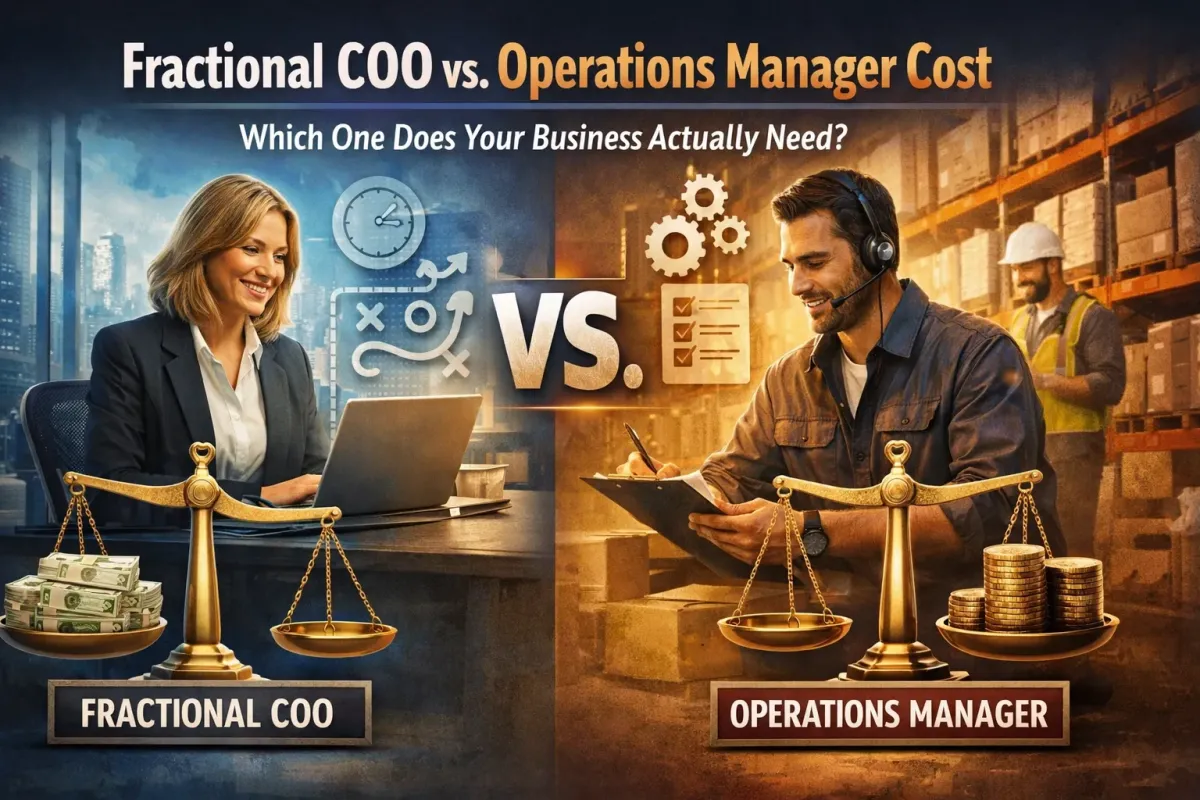
Fractional COO vs. Operations Manager Cost: Which One Does Your Business Actually Need?
Estimated read time: 7 minutes
Are you currently the biggest bottleneck in your own business?
If you’re a founder generating between $100k and $2M in revenue, you’ve likely hit "the wall." You’re answering every Slack message, approving every social media post, and your calendar looks like a game of Tetris played by someone who is losing. You know you need help. You know you need "Operations."
But as you start looking at the math, you’re faced with a fork in the road: Do you hire a full-time Operations Manager, or do you bring in a Fractional COO?
One feels like a safe, traditional hire. The other feels like a high-level strategic play. Making the wrong choice isn't just a waste of money: it's a recipe for "micromanagement hell."
In this playbook, we’re going to break down the cost, the roles, and the exact methodology we use at OPS Framework to help you decide which path leads to freedom and which leads to more frustration.
The Architect vs. The Builder: Defining the Roles
Before we talk about dollars and cents, we have to talk about DNA. Most founders confuse these two roles because they both fall under the "Operations" umbrella. However, the difference is the difference between an architect and a construction foreman.
The Operations Manager (The Builder)
An Operations Manager is a tactical hire. Their job is to manage the daily execution of existing systems. They keep the trains running on time. If you already have a clear set of SOPs, a proven workflow, and a team that just needs a "boss" to check their work, an Ops Manager is your person.
Focus: Tactical execution, daily oversight, team management.
The Trap: If you don't have systems yet, your Ops Manager will look to you to tell them how to do everything. You haven't removed the bottleneck; you’ve just added a middleman to the bottleneck.
The Fractional COO (The Architect)
A Fractional COO (Chief Operating Officer) is a strategic partner. They don't just manage the systems; they build the systems. They operate at the executive level, looking at your business through the lens of the OPS Framework (Operate, Plan, Scale). They are there to bridge the gap between your visionary ideas and the team's ability to execute.
Focus: Strategic leadership, system design, scaling architecture, high-level unblocking.
The Benefit: They bring the "playbook" with them. You aren't teaching them how to help you; they are teaching you how to scale.

The Real Cost Comparison: Salary vs. Strategy
Let’s look at the numbers. When you’re in that $100k–$2M range, every dollar of overhead needs to be a multiplier, not just an expense.
1. The Operations Manager Cost
A mid-level Operations Manager typically commands a salary between $85,000 and $115,000 per year.
But that’s not the "real" cost. Once you add in payroll taxes, benefits, equipment, and the "management tax" (the time you spend training them), you’re looking at a $130k+ commitment.
The Risk: If they are a "doer" and not a "builder," you are paying six figures for someone who still needs you to hold their hand.
2. The Full-Time COO Cost
A seasoned, executive-level COO is out of reach for most businesses under $5M. You’re looking at a base salary of $200,000 to $300,000, plus equity and significant bonuses. For a founder doing $1M in revenue, this is a non-starter.
3. The Fractional COO Cost
A Fractional COO provides the $250k-level brainpower for a fraction of the price. Typical engagements range from $5,000 to $15,000 per month, depending on the complexity of your business.
The ROI: You aren't paying for 40 hours of "sitting at a desk." You are paying for the outcome. You are paying for the implementation of a system like our A.I.M. Methodology (Action Plan, Implement, Measure) that actually removes you from the day-to-day.
Why Hiring an Ops Manager Too Early Leads to "Micromanagement Hell"
This is the biggest mistake we see at OPS Framework. A founder is overwhelmed, so they hire a $70k "Junior Ops Manager" to take things off their plate.
Three months later, the founder is more stressed than ever. Why? Because they are now spending 10 hours a week answering the Ops Manager’s questions.
If you haven't built the "Growth Engine" yet, you can't hire a driver.
Without a strategic foundation, an Ops Manager becomes a glorified personal assistant. You end up micromanaging them because there is no standardized "way of doing things." To avoid this, you need to transition from "Owner-Led" to "System-Led."

How the A.I.M. Methodology Solves the Bottleneck
Whether you choose a Fractional COO or eventually hire an Ops Manager, the work remains the same. You need a framework to move from chaos to clarity. At OPS Framework, we use the A.I.M. system:
Action Plan: We don't just "do work." We create a strategic roadmap. What are the key results? How do we align your team with your vision? This is where we master OKRs to ensure everyone is pulling in the same direction.
Implement: This is the "building" phase. We create the SOPs, automate the manual tasks, and unlock your team's potential through better workflows.
Measure: We don't guess; we track. We set up the dashboards and KPIs so you can see the health of your business at a glance without having to ask five different people.
The Decision Matrix: Which One Do You Need?
Still not sure? Ask yourself these three questions:
1. Is my problem "People" or "Process"?
If you have the processes but the people aren't doing them, you need an Operations Manager.
If you don't even know what the processes should be, you need a Fractional COO.
2. Am I looking for a "Taker" or a "Giver"?
An Ops Manager is a "task taker." You give them work; they do it.
A Fractional COO is a "strategy giver." They tell you what needs to be done to reach your goals.
3. What is my current revenue?
$100k - $500k: You likely need a high-level consultant or a "3-Step Reset" to find where the leaks are. Check out our 3-Step Reset for Smarter Growth.
$500k - $2M: This is the sweet spot for a Fractional COO. You need the systems built now so you can scale to $5M+ without breaking.
$5M+: You likely need both: a Fractional (or full-time) COO for strategy and an Ops Manager for daily tactics.

Your Path to Scaling Without Burnout
Building a business is hard. Scaling one is even harder. But the truth is, you didn't start this company to spend 14 hours a day in the weeds of project management. You started it to make an impact and have freedom.
Trust is the glue of a high-performing team, but systems are the growth engine. If you feel like you are the only thing holding your business together, it’s time to stop hiring "help" and start hiring "leadership."
The "Fractional" model allows you to get C-suite expertise without the C-suite price tag. It gives you the Fractional COO Playbook you need to actually step back and be the CEO.
Stop Guessing. Start Scaling.
If you’re tired of being the bottleneck and you’re ready to see what the OPS Framework can do for your business, let’s talk. We’ll look at your current "bottlenecks," analyze your team structure, and determine if a Fractional COO is the missing piece of your puzzle.
Ready to get your time back?