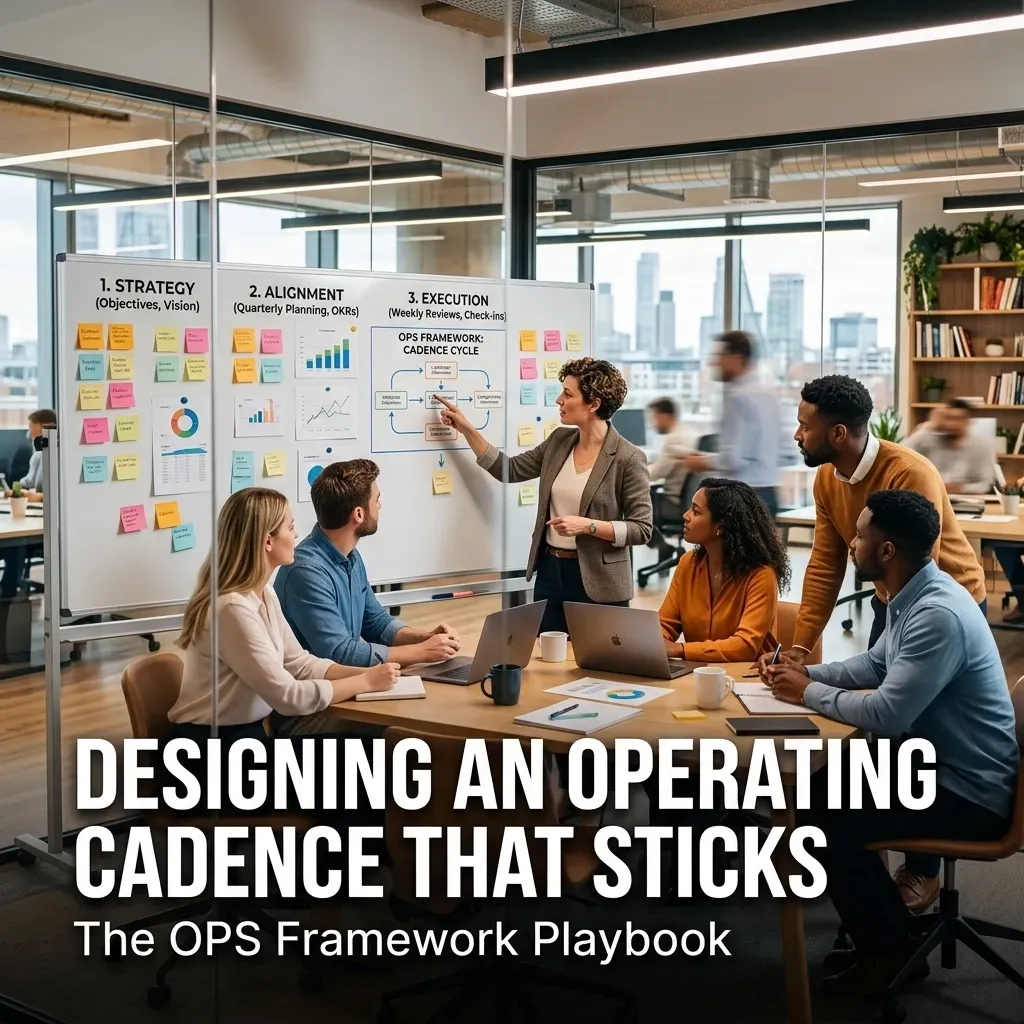
Designing an Operating Cadence That Sticks: The OPS Framework Playbook
Estimated Read Time: 8 minutes
Are your days a blur of back-to-back Zoom calls that leave you wondering when you’ll actually get "real work" done? Do you feel like you’re constantly reacting to fires instead of leading your team toward a clear vision?
If you’re nodding your head, you’re likely suffering from a lack of structure. Most founders and executives find themselves trapped in a cycle of meeting fatigue and operational chaos because they haven’t mastered their operating cadence. Without a rhythmic heartbeat, your business doesn't just slow down: it burns out.
At OPS Framework, we believe that operational efficiency isn't about working more; it’s about working in a rhythm. In this playbook, we’ll show you how to design an operating cadence that transforms your leadership from reactive to proactive, providing the ultimate leadership burnout solutions.
What is an Operating Cadence? (The Heartbeat of Your Business)
Think of your company as a living organism. If the strategy is the brain and the people are the muscles, the operating cadence is the heartbeat.
What it is: An operating cadence is the consistent, predictable rhythm of meetings, reviews, and data check-ins that keep your team aligned and moving forward. It’s the ritual of reflection and execution.
Why it matters: Without a cadence, information gets trapped in silos. You find yourself answering the same questions five times a day. Decision-making slows to a crawl. A well-designed cadence creates a "source of truth" and a "ritual" for every layer of the business. It is the engine that drives your business operating systems.
Choosing Your Forums, Rhythms, and Inputs
Designing a cadence isn't just about throwing recurring invites on a calendar. It’s about intentionality. To build a system that sticks, you need to define three things: Forums, Rhythms, and Inputs.
1. The Forums (The "Where" and "Who")
A forum is the specific environment where a review or discussion takes place. Not every meeting should have the same attendees or the same vibe.
The Executive Forum: High-level strategy, OKR alignment, and big-picture roadblocks.
The Departmental Forum: Tactical execution, resource allocation, and team-specific KPIs.
The 1-on-1 Forum: Coaching, personal development, and individual accountability.
2. The Rhythms (The "How Often")
Effective cadences operate at three speeds. If you only move at one speed, you’ll either get lost in the weeds or lose sight of the horizon.
Annual (Strategic): The "Big Picture" planning. Where are we going in the next 12 months?
Quarterly (Tactical): Setting OKRs and reviewing the previous 90 days. This is the pivot point for your business.
Weekly/Daily (Operational): The "Engine Room." Tracking progress, unblocking tasks, and maintaining momentum.
3. The Inputs (The "What")
What data are you bringing to the table? If a meeting doesn't have inputs, it’s just a chat. Inputs include:
Key Performance Indicators (KPIs): The hard numbers.
OKR Progress: Are we on track for our quarterly goals? Check out our Mastering OKRs post for more.
Roadblocks: What is stopping the team from winning this week?

Building Your Cadence with the A.I.M. to Win Framework
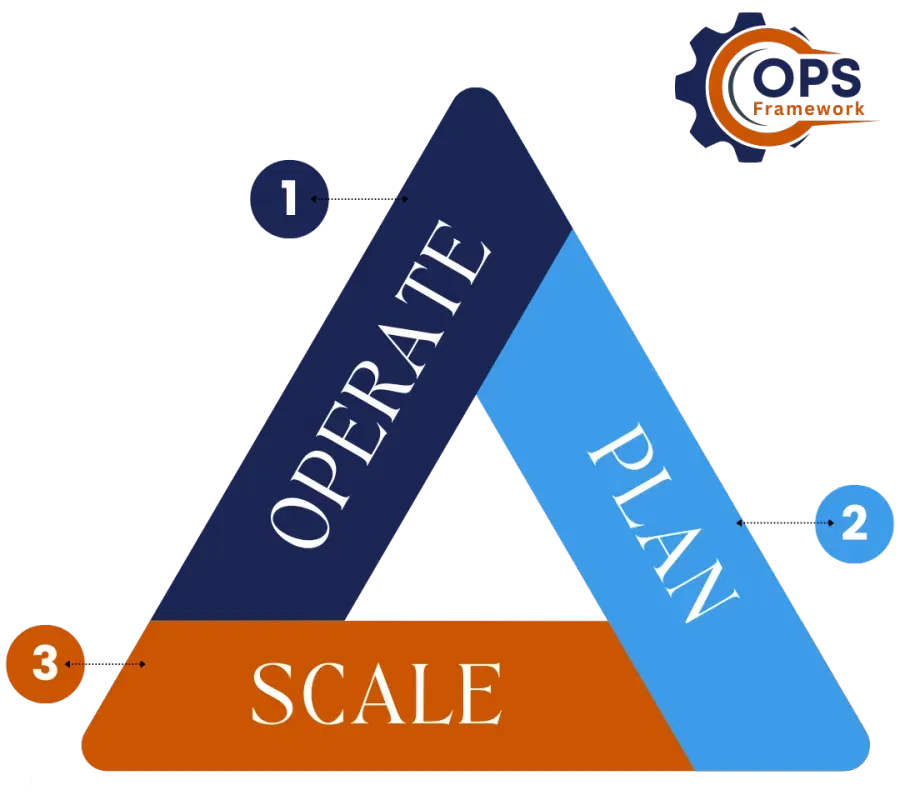
At OPS Framework, we use the A.I.M. to Win framework to help businesses scale without the mess. Here is how you can apply it to design your operating cadence.
Step 1: Action Plan (Design Your System)
Don't just copy someone else's schedule. Look at your specific bottlenecks. Are you failing to hit goals? You likely need a stronger Monthly Business Review (MBR). Are your teams disconnected? You need a better Weekly Leadership Sync.
Identify the Gaps: Where is communication breaking down?
Map the Meetings: Define the purpose, the owner, and the required inputs for every recurring meeting.
Step 2: Implement (Launch the Rituals)
Implementation is where most leaders fail because they don't commit to the "ritual" aspect.
Standardize the Agenda: Use a consistent template for every forum. This reduces cognitive load.
Set the Source of Truth: Whether it’s a dashboard or an OKR workbook, ensure everyone is looking at the same data.
Start Small: Don't overhaul everything in a week. Start with a solid Weekly Leadership Sync and build from there.

Step 3: Measure (Refine and Optimize)
Your operating cadence is not set in stone. It is a product that you should iterate on.
Audit Your Meetings: Every 90 days, ask: "Is this forum still serving its purpose?"
Feedback Loops: Ask your team if they feel informed or overwhelmed.
Trim the Fat: If a meeting has turned into a status update that could have been an asynchronous Slack message, kill it or change the format.
Tips to Make Your Cadence "Stick"
We’ve all seen it: a company launches a new "Weekly Sync," and by week four, half the team is missing and the other half is on their phones. Here is how you ensure your cadence becomes part of the company DNA:
Strict "No-Agenda, No-Attenda" Rule: If there isn't a documented agenda and required inputs 24 hours before the meeting, cancel it.
Focus on Outcomes, Not Updates: Use your time to solve problems, not to read status updates that people could have read in a report.
End with Action Items: Every meeting must end with: Who is doing What by When?
The 5-Minute Rule: If a discussion starts getting too granular for the current forum, "table it" for a separate breakout. Don't waste ten people's time on a two-person problem.
Common Pitfalls to Avoid
Meeting Overload: More meetings do not equal more alignment. If you have a solid "source of truth" (data), you need fewer meetings.
Lack of Preparation: If people are "winging it," you’ve already lost. Preparation is the price of admission.
Ignoring the Personal: In the rush for operational efficiency, don't forget the human element. Ensure your cadence includes space for team wins and culture building.
Revolutionize Your Operations Today
Designing an operating cadence is the single most effective way to solve leadership burnout. It moves the weight of the business from your shoulders onto the "system." When the system has a heartbeat, you can finally step back and lead.
Ready to stop the chaos and start scaling?
Take your next step:
Download our OKR Workbook to get your inputs right.
Learn how a Fractional COO can build this cadence for you.
Or, if you’re ready to transform your business today, book a connection call with us.
Your business deserves a heartbeat. Let’s build it together.