
A Field Guide for Operators in High-Growth Companies: Patterns, Pitfalls, and Power Moves
Reading time: 9 minutes
Let’s be honest: scaling a company feels a lot like trying to assemble a Lego Technic set while riding a rollercoaster. In the dark. During an earthquake.
If you are the person responsible for the "how" of the business: the Operator, the Chief of Staff, or the person who just realized they’ve become a de facto fractional coo: you know the chaos. One day you’re celebrating a record-breaking sales month; the next, you’re realizing your onboarding process is held together by three sticky notes and a prayer.
At OPS Framework, we’ve seen inside the engines of dozens of high-growth companies. We’ve seen the ones that hum like a Tesla and the ones that smoke like a 1984 beat-up truck. The difference isn't just "luck" or "having a great product." It’s the operating system.
This is your field guide to the patterns that drive success, the anti-patterns that kill momentum, and the leverage points where you can actually get an ROI on your sanity.
The Patterns of Success: What "Good" Looks Like
When we walk into a business that is actually scaling without breaking its people, we notice a few recurring "DNA strands." These aren't accidental; they are intentional choices.
1. Radical Transparency (The "No Secrets" Policy)
In high-growth environments, information is the lifeblood. When data is siloed, people make bad decisions. Successful operators ensure that everyone from the C-suite to the interns knows what the North Star is and how we are tracking against it. This isn't just about sharing a spreadsheet; it's about building a culture where the "red" metrics are discussed as openly as the "green" ones.
2. Extreme Ownership (The RACI-less RACI)
We’ve all been in that meeting where someone asks, "Who owns this?" and the room goes silent. Success patterns involve clear, unambiguous ownership. Whether you use a formal RACI or just a "Single Point of Accountability," the goal is the same: when a ball is dropped, we know exactly whose hands it was supposed to be in. No more "I thought you had it" emails.
3. Documentation as a Default
"Move fast and break things" only works if you record how you fixed them. High-leverage operators treat documentation not as a chore, but as an asset. If a process isn't written down, it doesn't exist. This is the secret to operational efficiency for small business: it stops you from answering the same question fifteen times a week.

The Anti-Patterns: The Traps That Kill Growth
If the patterns above are the fuel, these anti-patterns are the sugar in the gas tank. Watch out for these common traps.
1. Over-Engineering (The "Ferrari in a School Zone" Trap)
We see this all the time: a startup with ten employees trying to implement a management system designed for GE. If your operating system requires three full-time people just to maintain the software, you’ve over-engineered. Your OS should serve the business, not the other way around. Keep it as simple as possible, but no simpler.
2. The "Set It and Forget It" Mentality
Systems are living organisms. They require maintenance. We’ve seen companies spend $50k on a strategic business transformation only to let the dashboards gather digital dust three months later. If you aren't reviewing your rhythms and inputs quarterly, your "system" is just a memory.
3. The "Franken-Stack"
This is when you have seven different tools that don't talk to each other. Slack for comms, Asana for tasks, a custom Google Sheet for OKRs, and something else for CRM. The friction of moving data between these tools creates a "tax" on your team’s productivity. A key move for any operator is consolidating the stack to reduce cognitive load.
Strategic Leverage Points: Where to Place Your Bets
As an operator, your time is your most precious resource. You can't fix everything at once. You need to find the leverage points: the places where a 1% improvement in input leads to a 10% improvement in output.
The Hiring Onramp: If you are growing, you are hiring. Automating and systematizing the first 30 days of an employee's life is a massive leverage point. It scales culture and competence simultaneously.
The Meeting Cadence: Most meetings are a waste of time. Redesigning your "operating cadence": the rhythm of daily, weekly, and monthly reviews: is how you reclaim 10+ hours a week for your leadership team.
The Feedback Loop: How fast can you catch a mistake? If it takes you a month to realize a marketing campaign is failing, you’re losing money. Moving your measurement from "lagging" (end of month) to "leading" (weekly) is a power move.
The A.I.M. to Win Playbook: How to Implement
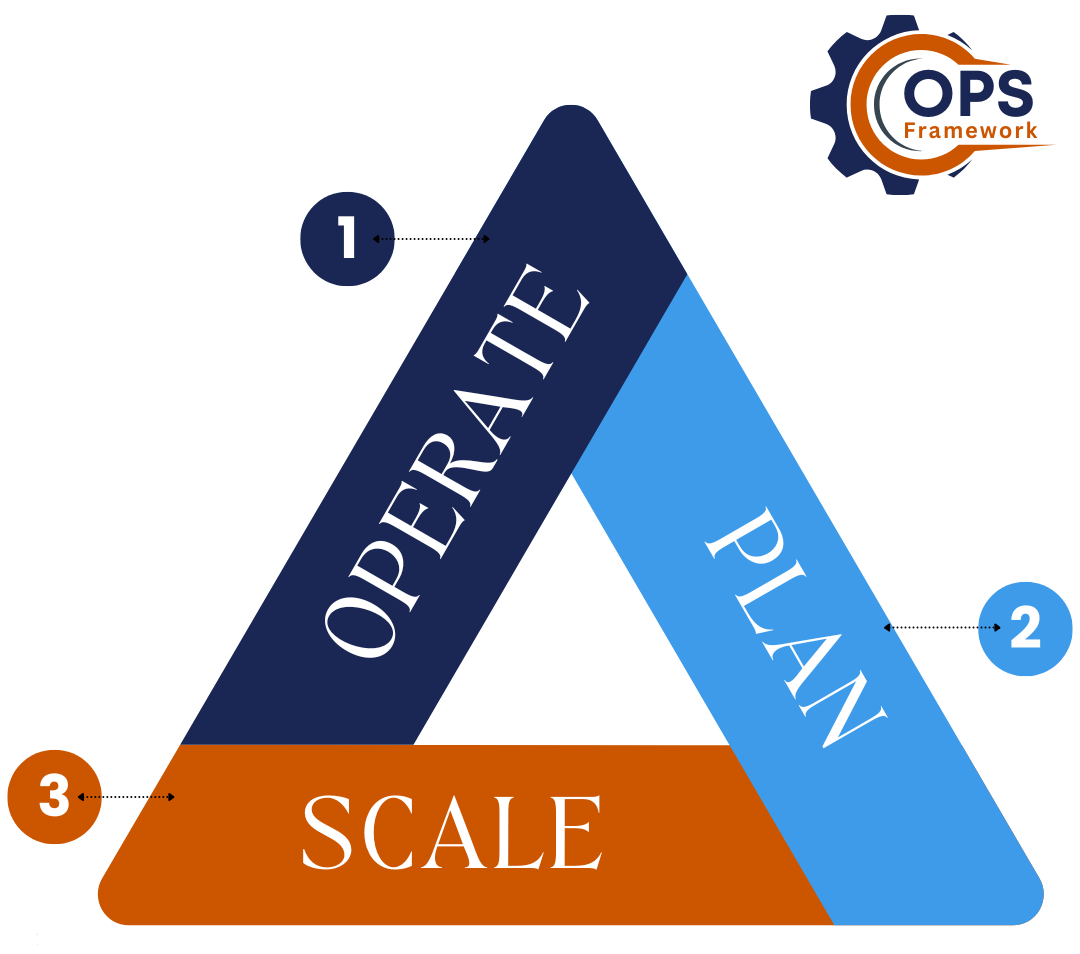
Theory is great, but execution is everything. At OPS Framework, we use the A.I.M. to Win framework to guide every implementation. If you want to build an operating system that actually sticks, follow these three steps.
1. Action Plan (The Strategy)
Before you touch a single software tool, you need a plan. What are the 3-5 key objectives for the next year? How do those break down into quarterly goals?
The Goal: Define the "What" and the "Why."
Pro Tip: Use our OKR Workbook to get the team aligned. If everyone isn't rowing in the same direction, it doesn't matter how fast you row.
2. Implement (The Execution)
This is where the rubber meets the road. You build the forums, choose the rhythms, and set the inputs.
The Goal: Build the "How."
Common Barrier: Resistance to change. People like their old, chaotic ways because they are familiar. To overcome this, you must show them the "WIIFM" (What’s In It For Me). Less friction, fewer pointless meetings, and clearer expectations are usually enough to win them over.
3. Measure (The Feedback)
You cannot manage what you do not measure. This isn't just about financial KPIs; it’s about operational health. Are we hitting our deadlines? Is the team burnt out?
The Goal: Create a "Scoreboard."
Power Move: High-growth companies need to measure both outcomes and activities. If you only measure the finish line, you won't know you've tripped until the race is over. Check out our thoughts on mastering OKRs for a deeper dive here.
Best Practices for High-Growth Operators
Start Small: Don't try to overhaul the whole company in a week. Pick one department (Sales or Ops usually works best) and pilot the new system there first.
The 80/20 Rule: 80% of your results will come from 20% of your processes. Find that 20% and obsess over them.
Be a Guardian, Not a Dictator: Your job is to protect the system. When someone tries to bypass the process "just this once," you have to be the one to steer them back.
Iterate Constantly: If a meeting isn't working, change it. If a tool is too complex, ditch it. The goal is flow, not perfection.
Ready to Scale Without the Chaos?
Operating a high-growth company is one of the hardest jobs in business. It requires a unique blend of strategic vision and "in the trenches" execution. You are the architect of the growth engine, and the blueprint you choose matters.
Whether you are looking for business scaling strategies to get past a plateau or you've realized you need the expertise of a fractional leader to bridge the gap, we are here to help.
Don't let your growth become your bottleneck. It’s time to stop reacting to the chaos and start leading the transformation.
Ready to see where your biggest operational bottlenecks are?
Take our Bottleneck Assessment and let’s find out where you’re leaving leverage on the table. Or, if you’re ready to dive straight in, book a connection call with us today. Let’s build an operating system that actually wins.